Total Pageviews
Friday, June 3, 2016
Fall of Rome
http://www.history.com/topics/ancient-history/ancient-rome/videos/the-fall-of-rome (VIDEO TO WATCH)
Study Notes in the site below
http://studyhallsuis.weebly.com/roman-army--roman-empire.html
The Fall of Rome
Rome ruled much of Europe around the Mediterranean for over 1000 years. However, the inner workings of the Roman Empire began to decline starting around 200 AD. By 400 AD Rome was struggling under the weight of its giant empire. The city of Rome finally fell in 476 AD.
The Peak of Roman Power
Rome reached its peak of power in the 2nd century around the year 117 AD under the rule of the great Roman emperor Trajan. Virtually all of the coastline along the Mediterranean Sea was part of the Roman Empire. This included Spain, Italy, France, southern Britain, Turkey, Israel, Egypt, and northern Africa.
Gradual Decline
The Fall of Rome didn't happen in a day, it happened over a long period of time. There are a number of reasons why the empire began to fail. Here are some of the causes of the fall of the Roman Empire:
- The politicians and rulers of Rome became more and more corrupt
- Infighting and civil wars within the Empire
- Attacks from barbarian tribes outside of the empire such as the Visigoths, Huns, Franks, and Vandals.
- The Roman army was no longer a dominant force
- The empire became so large it was difficult to govern
Rome Divides into Two
In 285 AD, Emperor Diocletian decided that the Roman Empire was too big to manage. He divided the Empire into two parts, the Eastern Roman Empire and the Western Roman Empire. Over the next hundred years or so, Rome would be reunited, split into three parts, and split in two again. Finally, in 395 AD, the empire was split into two for good. The Western Empire was ruled by Rome, the Eastern Empire was ruled by Constantinople.

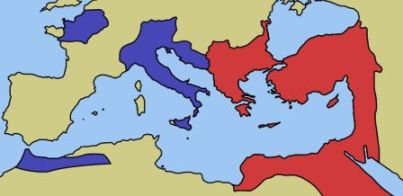
Map of the Eastern and Western Roman Empire right before the fall
The "fall" of Rome discussed here is referring to the Western Roman Empire which was ruled by Rome. The Eastern Roman Empire became known as the Byzantium Empire and remained in power for another 1000 years.
The City of Rome is Sacked
The city of Rome was thought by many to be unconquerable. However, in 410 AD, a Germanic barbarian tribe called the Visigoths invaded the city. They looted the treasures, killed and enslaved many Romans, and destroyed many buildings. This was the first time in 800 years that the city of Rome had been sacked.
Rome Falls
In 476 AD, a Germanic barbarian by the name of Odoacer took control of Rome. He became king of Italy and forced the last emperor of Rome, Romulus Augustulus, to give up his crown. Many historians consider this to be the end of the Roman Empire.
The Dark Ages Begins
With the fall of Rome, many changes occurred throughout Europe. Rome had provided a strong government, education, and culture. Now much of Europe fell into barbarianism. The next 500 years would be known as the Dark Ages of Europe.
Interesting Facts about the Fall of Rome
- The Eastern Roman Empire, or Byzantium, fell in 1453 to the Ottoman Empire.
- Many poor people were glad to see Rome fall. They were starving to death while being taxed heavily by Rome.
- Near the end of the Roman Empire, the city of Rome was no longer the capital. The city of Mediolanum (now Milan) was capital for a while. Later, the capital was moved to Ravenna.
- Rome was sacked once again in 455 AD by Geiseric, King of the Vandals. The Vandals were an Eastern Germanic tribe. The term "vandalism" comes from the Vandals.
The Rise and Fall of Ancient Rome
http://en.wikipedia.org/wiki/File:Roman_Republic_Empire_map_fast.gif

Map of the Roman Empire based on Image:BlankMap-Europe-v3.png, displayed in the map:
- Red = Roman republic 510BC-40BC
- Purple = Roman Empire 20AD-360AD
- Blue = Western Roman Empire 405AD-480AD
- Green = Eastern Roman Empire 405AD-480AD
Reasons For the Decline of Ancient Rome
Rome - Kingdom, Republic and Empire together - lasted about 1200 years. Rome ruled all around the Mediterranean and large sections of Europe and Southwest Asia. Yet in the end, the problems grew too great and the Western Roman Empire fell.
Why did the empire fall apart?
There is no one single reason, but a series of problems that grew too large to solve.
1. The empire grew too large to govern. The Romans tried to solve this by dividing the empire.
2. The Romans no longer wanted to serve in the army. The Romans tried to solve this by hiring barbarians to fight for them.
3,Civil wars broke out in Rome between different factions.
4.The rich grew disinterested in helping Rome and only wanted more for themselves and their families.
5.The population of Rome shrank.
6.Trade decreased while taxes and prices increased. The poor were overtaxed.
7.The use of slaves put people out of work.
The Romans were aware of these problems and sometimes, under a good emperor, they would work on them for a while. In time, the good emperor would be gone and a bad one would take his place. Soon the problems in the Western Roman Empire grew so great that the Western (European) Roman empire fell to barbarian tribes in Europe.
In Europe there were five major barbarian tribes - the Huns, Franks, Vandals, Saxons, and Visigoths (Goths) - and all of them hated Rome. Each of the barbarian tribes wanted to destroy Rome. The Barbarians were destroying Roman towns and cities in the outer regions of the empire. The only reason that they had not destroyed Rome yet was they spent almost as much time fighting each other as they did Rome.
The Eastern Roman empire continued another 1000 years.
Rome Falls
In 476 AD, a Germanic barbarian by the name of Odoacer took control of Rome. He became king of Italy and forced the last emperor of Rome, Romulus Augustulus, to give up his crown. Many historians consider this to be the end of the Roman Empire.
Sunday, April 10, 2016
The Twelve Tables of Rome
he Twelve Tables of Ancient Rome[11]
The twelve tables of Rome were the laws of Rome and the foundation for their first written constitution. They outline the basic human rights and create mandates for different situations some bad, some good. The twelve tables were written by and for the two classes of people in Rome at the time,the Patricians and the Plebeians. The Patricians were the upper class, lawmaking, voting, landowning, and ruling people of Rome, they wanted the twelve tables mostly to keep the Plebeians in check and in their own class. The Plebeians were the lower class workers, farmers, ect... Most of the 6th century B.C. was ruled by the Patricians who made laws to keep themselves rich and in power and the Plebeians suffered from this. The plebeians were upset with the current system of laws, they were willing to secede from Rome if they were given an alternative. By the 5th century B.C. they had come to an agreement on the twelve tables.


These laws talked about property, crime, family, theft, marriage and inheritance.The laws tried to be fair on most accounts. These were the first laws written down. They were engraved on stone tablets and put on display at the Forum in the city of Rome, so that everyone could see them and know the laws of Rome. This is assumed to have helped their crime rates and made Rome a better place.
The twelve laws that they had decided on were as follows:
Table I: If a person is summoned to a court, they must go, or they will be taken. If they run they will be captured.
Table II: If a judge or a member of either side is taken ill, or must meet and enemy, etc... The Precedings must end or be postponed.
Table III: A person in debt has 30 days to pay off the debt or the debtor may take the debt back..
Table IV: A child that is born to a deformity must be put to death. any son who is sold by his father into slavery three times may be free from that father.
Table V: If a person dies without a will the nearest male kinsman may inherit their belongings. If a person goes mad, the nearest male kinsman may take their belongings and responsibility for the person.
Table VI: If someone says something is theirs orally, it is theirs. No one is allowed to displace a beam from a building or a vineyard.
Table VII: Property owners are responsible for their own roads where there is right of way, and if it is not kept, people may go where they please.
Table VIII: If someone breaks another mans hand he must pay 300, slaves 150, if a man kills another mans crops he must pay...if you cause injury accidentally, you owe a ram
Table IX: A judge shall be put to death if he is found taking a bribe. A person committing treason shall be put to death.
Table X: No man shall be cremated within a city.
Table XI: marriage between Plabeians and Patricians is prohibited.
Table XII: If a person gives false witness they shall be thrown from the Tarpeian rock

http://romanhistoryhour7.wikispaces.com/1.+2000+BCE+to+450+BCE
http://rome.mrdonn.org/12tables.html
Government under the Roman Republic
Structure of the Government 509BC
2 Consuls
Head of Government |
Senate (300
members)
|
Assembly
|
PATRICIANS
|
PATRICIANS
|
PLEBEIANS
|
1 year term
|
Life term
|
|
Consuls chose the Senators
|
Elected the 2 Consuls
|
|
Ran the
government, overseeing the work of other government officials.
|
Advised
the consuls. Advised the Assembly.
|
Elected
government officials including judges.
|
Directed (commanded) the army
|
Directed spending, including tax dollars
|
|
Acted as judges
|
Approved
or disapproved laws made by the Assembly
|
Voted
on laws suggested by government officials
|
In an
emergency, consuls could choose a dictator – a single ruler to make quick
decisions.
|
Made
decisions concerning relationships with foreign powers
|
Declared war or peace
|
Both
consuls had to agree on their decisions. Each had the power to Veto the
other. In Latin, veto means “I forbid.”
|
http://rome.mrdonn.org/senate.html
|
Leasdership in Ancient Rome.
How is power gained, used and justified?
What kind of leadership do we have in Brazil?
Why do we have laws?
What are the 12 Tables?
Watch video.
http://www.mrdowling.com/702-patricians.html
Subscribe to:
Posts (Atom)