Total Pageviews

Wednesday, November 20, 2013

Life as a Slave


The life as a slave was very difficult. Here are some things that were in a slave’s life.
Clothing:
Every year, slaves usually received two linen shirts, two pairs of trousers , one jacket, one pair of socks, one pair of shoes, an overcoat, and a wool hat.
Food:
Slaves usually received cornmeal salt herrings, and eight pounds of pork or fish each month for food.
Housing:
Slaves houses were usually wooden shacks with dirt floors, but sometimes houses were made of boards nailed up with cracks stuffed with rags. The beds were collected pieces of straw or grass, and old rags, and only one blanket for a covering. A single room could have up to a dozen people-men, women, and children.
Childhood:
When a slave was only 12 months old his/her mother could be sold far away. When a slave was four, they sometimes worked as a babysitter. When a slave was around the age of five, they would run errands and carry water to the field slaves. Around the age of eight, children would be expected to work on the plantation.
Families:
Over 32% of marriages were canceled by masters as a result of slaves being sold away from the family home. A slave husband could be parted from his wife, and children from their mothers.
Punishments:
Slaves could be killed for murder, burglary, arson, and assault upon a white person. Plantation owners believed that this severe discipline would make the slaves too scared to rebel.
In South Carolina one slave owner would put nails in a barrel sticking out on the inside of the barrel, then put the slave in and roll him/her down a very long and steep hill. Another punishment slave owners used was to whip their slaves. Other slave owners in Virginia smoked their slaves. This involved whipping them and putting them in a tobacco smokehouse.
Some other punishments were getting beaten with a chair, broom, tongs, shovel, shears, knife handles, the heavy end of a woman’s shoe, and an oak club.
Religion:
On of the main reasons masters didn’t want their slaves to become Christians involved the Bible. This was one reason why most plantation owners did what they could to stop their slaves from learning to read. In the South, black people were not usually allowed to attend church services. Black people in the North were more likely to attend church services. Drums, which were used in traditional religious ceremonies, where banned because overseers worried that they would be used to send messages.


For more information visit the following sites:


http://library.thinkquest.org/03oct/00394/life.htm


http://education-portal.com/academy/lesson/rise-of-slave-trade-black-history-in-colonial-america.html#lesson


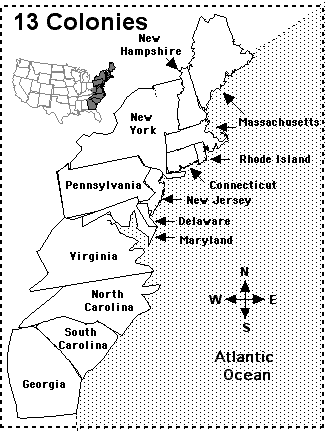
13 Colonies Map


Saturday, November 9, 2013

Dutch and French Colonies


After reading the text, copy this chart in your blog book.

1. Complete the chart based on Dutch and French Colonies.
Consider: trading, relations with Indians,religion and location.
2. Find the meaning of these words : diversity, tolerance and missionary. Write the meanings in the blog book.


Sunday, November 3, 2013

Jamestown: A Story of Success and Failure


I. The People
            A. Too many gentlemen
                        1. They were not experienced with physical labor
                        2. Many refused to work
                        3. Many only wanted their servants to look for gold
            B) No farmers
            C) Many laborers
                        1. Many wanted to look for gold instead of work
                        2. Some didn’t work hard because of a lack of personal property

II. Relationship with the Natives
            A) Built a fort for protection
            B) Used violence to intimidate Natives
            C) Made some attempts at peace with Natives
            D) Always under a threat of an attack from Natives

III. Captain John Smith
            A) Arrested for mutiny on the voyage to Virginia
            B) Military and leadership skills help colony survive
            C) Captured, almost executed by Natives
            D) Gave gentlemen a choice: work or starve
            E) Left Jamestown in 1608

IV.Food
            A) Settlers had little food
            B) Many settlers died from disease or starvation
            C) Relied on trade with Natives for food
            D) Attacked and stole food from Natives
            E) Starving Time
                        1. Took place from October 1609 to March 1610
2. Natives refuse to trade with Settlers
                        3. 440 of 500 colonists died

V. Tobacco
            A) The Good
1. Natives taught settlers to grow, cure and smoke tobacco
                        2. Traders introduce the tobacco to Europeans
                        3. Europeans buy tobacco from settlers
                        4. Colony becomes profitable
            B) The Bad
                        1. Tobacco farms create a need for cheap labor.      
                                   a) Captured Africans become enslaved.
                                   b) Generations of slavery result in part because of tobacco

                        2. Tobacco-related deaths still plague the modern world


teachers.bcps.org/.../B9191FC9D45646C1B1986650

Friday, August 2, 2013

Turbulent Times Create Change


With change comes the opportunity for inspiration, ideas and implementation.


Sunday, June 23, 2013

Dark Ages

The Dark Ages :The Dark Ages is a term used to describe the period between 400 and 1000 AD in Europe.

Early scholars gave the name "Dark Ages" to the period in Europe after the fall of the Roman Empire. During this period, barbarian Goths, Vandals, and Huns swept down on Europe from the north and east. They destroyed many fine buildings and works of art that had existed during Roman times. During the Dark Ages, knowledge survived only in monasteries, and there were very few schools. Many of the old arts and crafts were lost. This is why the time was called the "Dark Ages."


The eastern Roman Empire was not conquered by the barbarians. There, the arts still flourished. People were still thinking and making fine works of art in other parts of the world. In China and India, great civilizations grew and spread. 

In the 1000s, Europe began to slowly recover from its artistic darkness. The lost knowledge of the ancient Greeks and Romans was found again. There was a new interest in learning, and the richer life of the Middle Ages began.

The Age of FeudalismDuring the Dark Ages many changes took place.
 Less writing, education, trade (called the Dark Ages)
 Political fragmentation. There were many leaders. The kings had less power because countries were divided into areas controlled by feudal lords. There were many barbaric tribes.
German political traditions differed - People were loyal to a tribe, not to a country. German legal traditions differed - They had laws for individual tribes. German cultural traditions - They had no written literature, and ruins were used for monuments.
 The Church preserved ancient writings and Biblical writings. The Christian Church helped unify people of Europe because of its centralized authority and hierarchical nature. The Church unified the people because it was the only constant.

Sunday, May 19, 2013

So,who was Spartacus?

Spartacus


By far the most famous gladiator in history, Spartacus was a Thracian soldier who had been captured and sold into slavery.  Lentulus Batiatus of Capua must have recognized his potential, for he purchased him with the intention of turning him into a gladiator.  But a warrior’s fierce independence is not easily given up: in 73 BC, Spartacus persuaded seventy of his fellow gladiators—Crixus included—to rebel against Batiatus. This revolt left their former owner murdered in the process, and the gladiators escaped to the slopes of nearby Mount Vesuvius.  While in transit, the group set free many other slaves—thereby amassing a large and powerful following.
The gladiators spent the winter of 72 BC training the newly freed slaves in preparation for what is now known as the Third Serville War, as their ranks swelled to as many as 70,000 individuals.  Whole legions were sent to kill Spartacus, but these were easily defeated by the fighting spirit and experience of the gladiators.  In 71 BC, Marcus Licinius Crassus amassed 50,000 well-trained Roman soldiers to pursue and defeat Spartacus.  Crassus trapped Spartacus in Southern Italy, routing his forces, and killing Spartacus in the process.  Six thousand of his followers were captured and crucified, their bodies made to line the road from Capua to Rome.

Famous Romans


Here are some of the most famous Romans of all times. These are by far not all famous Romans. For there are too many to mention. But here are some of the most outstanding figures Roman history created - and who created Roman history.  

marius.gif - 7580 Bytes
Marius
Vatican Museums
Vatican City
Marius - The great Man of the Army
Gaius Marius was the man who organized the army into the most effective fighting machine on earth. At times it appeared nothing could withstand the mighty legions of Rome. It was Marius who changed the way the army organized itself. Men from the provinces could now sign up to serve in the Roman army, and in time become Roman citizens themselves. So too was it Marius who granted land to the veterans of the legions in reward for their services.
He also won some famous battles with his new army, most famous of all the Aquae Sextiae and Campi Raudii, where his victories saved Italy and Rome from an invasion of barbarians from the north.
Caesar - General, Politician, Statesman
Julius Caesar is no doubt the most famous Roman of them all ! He conquered Gaul in a brilliant campaign which is still used in studies for training generals today. His victories in Gaul brought into the empire what should later become one of the most important new territories to the empire. The conquest of Gaul also brought the border of the empire to the river Rhine, where it should remain for centuries to come. He also led expeditions into Germany and Britain, which were at that time completely unknown to Romans. But his political enemies never stopped plotting against him and tried to take away his power. Caesar famously crossed the river Rubicon (which was the border between the province he ruled and the Italian territories of the Roman empire) and took power over Rome as a dictator. When away in Egypt he fell in love with the legendary Egyptian queen Cleopatra. Julius Caesar also reformed the calendar. With only minor changes his is the calendar we use today. One month, July, is named in his honour.
caesar.gif - 7123 Bytes
Julius Caesar
Museo della Civilta
Rome
augustus-01.gif - 10315 Bytes
Augustus
Museo della Civilta
Rome
Augustus - The first Emperor
Augustus was the first emperor of Rome. His real name was Octavian but he was given the name 'Augustus' by the senate as an honour for his great achievements. He avenged the death of Caesar together with Mark Antony, before falling out with him. He defeated Mark Antony together with the famous Egyptian queen Cleopatra and thereafter, together with the senate of Rome, created a new constitution for the great empire. Augustus stood at the head of this empire as the emperor. He used his ruled wisely and built roads, aqueducts and buildings. Not only was Augustus the first, but he was most certainly one of the best emperors Rome ever had.
Nero - The Madman of Rome
Nero is the most notorious Roman of all times. It is most likely that Nero was insane. He came to power because his mother murdered his step-father emperor Claudius. During his rule much of Rome burnt down in the Great Fire of Rome. Helpless to stop the fire, he is supposed to have sung as he watched Rome burn. After this he built himself a magnificent palace on some of the land cleared by the fire. To quell rumours that he had started the fire himself, he blamed the Christians for it and then had many captured and thrown to the lions in the circus.
nero-03.gif - 6921 Bytes
Nero
Capitoline Museums
Rome
trajan.gif - 10263 Bytes
Trajan
Museo della Civilta
Rome
Trajan - The kind-hearted Soldier
Trajan is one of Rome's most outstanding emperors. Under his rule the empire reached its largest extent. He famously conquered the rich kingdom of Dacia north of the Danube. Trajan was one of the greatest soldiers among the emperors. But unlike many of the later warrior-like rulers, he was also known for his wisdom and dignity, and his humility when dealing with the senate. Alike Augustus, Trajan's reign was a glittering one, during which many public works, roads and harbours were built. He also set up an imperial fund which should look after the poor, especially the children.
Constantine the Great - Unifier of the divided Empire
Constantine the great was the first Christian emperor of the Roman empire. He defeated all the other would-be emperors and re-united the empire, which had been divided between many rulers. He also decided to move the capital of the empire from Rome to a town called Byzantium, which he renamed after himself - Constantinopolis (Greek for: the city of Constantine). He also called together many bishops for the Council of Nicaea at which the exact nature of the Christian religion was defined. It is known today as the 'Nicene Creed'. For his many achievements he is known as 'Constantine the Great' and in the Christian church he is known as 'Saint Constantine'.
constantine.gif - 7790 Bytes
Constantine
Capitoline Museums
Rome

justinian.gif - 11137 Bytes
Justinian
Museo della Civilta
Rome
Justinian - The last 'Great' Emperor
Under the rule of Justinian, the eastern empire (the west had since fallen to the barbarians) enjoyed a last flowering. His great generals Belisarius and Narses reconquered many parts of the empire, including the city of Rome itself. So too is Justinian known to have collected the many Roman laws and created a unified code of laws, the so-called 'Justinian Code'. This code formed the basis of all systems of law in the western world. He also built many great buildings in his capital, the city of Constantinople. His most outstanding building is the great church Santa Sophia, which today is the famous mosque 'Aya Sophia' in the Turkish city of Istanbul.

Saturday, May 4, 2013

Engineering and Construction

The Romans were excellent engineers and builders. Many of the buildings and engineering projects they designed are still around today and some are still being used. Here are some of the projects that the Romans excelled in:

Roads

Roman Roads were important to the economy and the military of the Romans. They allowed for easier commerce between towns and cities and also allowed the Roman Legions to move quickly around the expanding empire.

The roads were designed to last despite the environment. They were built using many layers of masonry including concrete. These durable roads are still used today. They were also built with a hump making water flow to the edges. This kept the roads from flooding and allowed them to be used in rainy weather.

The Colosseum

The Colosseum in Rome is a great example of Roman engineering and construction. The Colosseum was a large outdoor stadium that could seat around 50,000 people for various forms of entertainment such as gladiator games, mock battles, and dramas. The huge Colosseum is free standing and built with multiple arches to give it strength. Much of it still stands today, although earthquakes have knocked portions of it down. It is 615 feet long and 510 feet wide and took around 131,000 cubic yards of stone to make.

Aqueducts

Aqueducts were long channels that the Romans built to carry water into the cities. Many of the Roman aqueducts were below ground. The water that was carried into the cities was used for drinking water, baths, and sewers. It was generally carried to a public fountain where people could then use buckets to get their water. Roman plumbing became so advanced that many of the large wealthy houses had running water.


Roman Aqueduct

Bridges

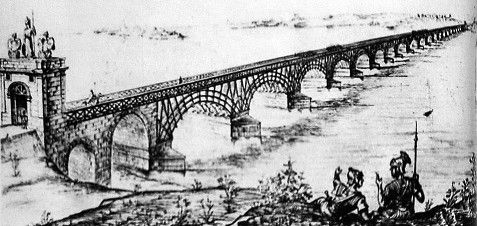
The Romans built long durable bridges. Many of their bridges still stand today. They used stone and concrete to build their bridges and used the arch as the basic architectural feature to make them strong. The largest Roman bridge ever built was the Trajan bridge over the river Danube. It was over 3700 feet long and 62 feet high.


The Trajan Bridge

Architecture

Roman engineering had a large influence on Roman architecture. Arches were used a lot due to their strength. The Romans also used domes as they enabled them to build large ceilings with wide open spaces.

Fun Facts about Roman Engineering
  • The Romans built over 400,000 km of roads including 29 highways that lead to the city of Rome.
  • The Latin word for road is via. The plural of via is viae. Roman roads generally had the name via in them, like the Via Appia or the Via Flaminia.
  • All the aqueducts in the city of Rome together totaled around 500 miles in length.
  • The Romans were among the first civilizations to harness water power.
  • It is estimated that the Romans built over 900 bridges in their empire.
 http://www.ducksters.com/history/ancient_roman_engineering.php

 For more information:
http://www.angelfire.com/hi5/interactive_learning/romanbuildingfiles/yr_7_roman_builbing.htm

Thursday, April 25, 2013

Wars and Battles


 The Ancient Romans fought many battles and wars in order to expand and protect their empire. There were also civil wars where Romans fought Romans in order to gain power. Here are some of the major battles and wars that the Romans fought.

The Punic Wars

The Punic Wars were fought between Rome and Carthage from 264 BC to 146 BC. Carthage was a large City located on the coast of North Africa. This sounds like a long way away at first, but Carthage was just a short sea voyage from Rome across the Mediterranean Sea. Both cities were major powers at the time and both were expanding their empires. As the empires grew, they began to clash and soon war had begun.

There were three major parts of the Punic wars and they were fought over the course of more than 100 years,
  • First Punic War (264 - 241 BC): The First Punic War was fought largely over the island of Sicily. This meant a lot of the fighting was at sea where Carthage had the advantage of a much stronger navy than Rome. However, Rome quickly built up a large navy of over 100 ships. Rome also invented the corvus, a type of assault bridge that allowed Rome's superior soldiers to board enemy navy vessels. Rome soon dominated Carthage and won the war.
  • Second Punic War (218 - 201 BC): In the Second Punic War, Carthage had more success fighting against the Roman legions. The Carthage leader and general, Hannibal, made a daring crossing of the Alps to attack Rome and northern Italy. This crossing was made more famous because he also brought a large number of elephants with him. Hannibal was a brilliant general and won several battles against the Romans. However, despite fighting for 16 years, Hannibal wasn't able to conquer the city of Rome. When Rome counterattacked his homeland of Carthage, Hannibal was forced to retreat. The final battle in this war was the Battle of Zama where the Roman general Scipio Africanus defeated Hannibal.
  • Third Punic War (149 - 146 BC): In the Third Punic War Rome attacked the city of Carthage. After three years of laying siege to the city, the Roman army broke through the walls and burned it to the ground.
 The Battle of Cynoscephalae (364 BC)

In this battle the Roman Legion under Titus Flamininus soundly defeated the Macedonian Army led by Philip V. This battle was important because the successors of Greek leader Alexander the Great had now been defeated. Rome had become the dominant world power.

Third Servile War (73 - 71 BC)

This war started when 78 gladiators, including their leader Spartacus, escaped and started a rebellion. Soon they had over 120,000 escaped slaves and others traveling with them invading the countryside. They successfully fought back many Roman soldiers until finally an army with a full 8 legions was dispatched to destroy them. The fighting was long and bitter, but eventually Spartacus' army was defeated.

Caesar's Civil War (49 - 45 BC)

This war is also called the Great Roman Civil War. Julius Caesar's legions fought against the Senate supported legions of Pompey the Great. The war lasted for four years until Caesar finally defeated Pompey and became Dictator of Rome. This signaled the end of the Roman Republic.

The famous moment in this war was when Caesar crossed the Rubicon River. This meant he was going to war against Rome. Today the term "crossing the Rubicon" is still used to say that someone had reached the point of no return and can not go back.

The Battle of Actium (31 BC)

In this battle Octavian's forces, led by Marcus Agrippa, defeated the combined forces of Roman general Marc Antony and Egyptian Pharaoh Cleopatra VII. As a result Octavian became the sole power in Rome and would soon become Rome's first Emperor. He would change his name to Augustus when he became emperor. 

http://www.ducksters.com/history/ancient_roman_wars_battles.php


Saturday, April 20, 2013

gladiators

                                         Gladiators
                                                                               20/4/2013


         The Huplomachus and Murmilo were both gladiators. They were heavily armored. The Huplomachus used a mini sword, and Murmilo used a helmet, a shild, a sword and a leg protector.


Sunday, April 7, 2013

Gladiators


Types of Gladiators


History, Facts and Information about Types of Gladiators

The content of this article provides interesting history, facts and information about different types of Gladiators. There were many different types of gladiators who were divided into different classes according to their weapons and fighting styles. There were strict rules and protocol surrounding the fights of gladiators. The pairing of the different types of gladiators was important and ironically the Romans expected to see 'fair play' in the gladiatorial combats. The selection of  'matched pairs' of different types of gladiators of would ensure that one fighter was hampered by heavy armor whilst the other was lightly armed. The different types of Gladiators have therefore been detailed on this page in four classes:
  • The Elite Types of Gladiators
  • Types of gladiators who heavily armed
  • Types of gladiators who lightly armed
  • Types of gladiators who specialised in unusual types of combat or entertainment
One type of gladiator might have freedom of movement but with little armor, or no armor to protect him. The other type of gladiator matched against him might be more heavily armed and protected but restricted in his movements by his armor.
Roman Gladiators
Roman Gladiators
Types of Gladiators - How many different Types of Gladiators fought in Ancient Rome?How many different types of Gladiators fought in Ancient Rome? Good question but we cannot provide a definitive answer. The history of the gladiators dates back over 2000 years and much of the information about them has been lost. We have, however, provided facts and interesting information about 26 different types of gladiator including their specialised fighting skills, their opponents and their weapons, clothing, armor and shields.
Names given to different Types of GladiatorsThe first Roman Gladiators were prisoners of war and were named according to their ethnic roots such as Samnite,  Thracian and the Gaul (Gallus).  Old enemies became allies and the names of the different types of gladiators changed to reflect their combat techniques such as Secutores (chasers), Bestiarii (beast fighters) and Retiarius (net fighters).
Types of Gladiators - List of the Elite
The elite types of Gladiators were the Rudiarius who were gladiators who had obtained their freedom but chose to continue fighting in gladiatorial combats, the Tertiarius who were experienced gladiators who acted as substitutes if a gladiator was unable to fight and the Sagittarius, a rare delight for the spectators, as these were highly accomplished mounted bowmen. Each of this type of gladiator was well known to the spectators, highly experienced and extremely skilful.
Types of Gladiators - List of Heavily armed Gladiators
The different Types of Gladiators who were heavily armed were as follows:
Types of Gladiators - List of Lightly armed Gladiators
The different Types of Gladiators who were heavily armed were as follows:
List of Unusual Types of Gladiators
There were also unusual types of Gladiators. These types of gladiators were forced to fight, or specialised in, unusual types of combat or entertainment. The Andabatae (Sight Restricted Gladiators) were convicted prisoners who were forced to wear helmets without any eye holes. No other armor was worn. They fought bare-chested and blindly lashed out at each other until the last man was standing. The Bestiarii (Beast Fighters) were lightly armored types of gladiators and fought wild animals. The Venatores were Wild Animal Hunters who entertained the spectators with their hunting skills. The Praegenarii were the 'opening act gladiators'. This type of gladiator only used wooden swords, accompanied to festive music. The Bustuarii was a type of slave gladiator who fought in combats to the death at the funerals of prominent Romans. The Naumachiarii were combatants in sea-fights - the arena of the Roman Colosseum was originally able to produce such sea battles for more information see Water Battles at the Colosseum. Facts and information about all of these different, unusual types of gladiators can be accessed via the following links:
Names of other Types of GladiatorsOther specific names were given to different types of gladiators according to their status and roles:
  • Auctorati - Definition: Roman citizens who were in debt and sold themselves to gladiator schools for money, swearing of a legal agreement agreeing to submit to beating, burning, and death by the sword if they did not perform as required. Auctorati gladiators were not deprived of their Roman citizenship
  • Tirones gladiatores or Tiro - Definition: Trainee gladiators
  • Veteranus (Veterani) - Definition: A trained gladiator and a veteran of one or more gladiatorial combats 
  • Meridiani - Definition: Lightly armed gladiators who fought in the middle of the day, after the wild beast fights
  • Ordinarii - Definition: These were the regular gladiators who fought in pairs in the ordinary way
  • Catervarii - Definition: Name given to gladiators when they did not fight in pairs, but when several fought together
  • Noxii - Definition:  Criminals who had been sentenced to death fighting as gladiators in the arena
  • Gladiatores Fiscales were maintained by the private treasury of the emperor
  • Gladiatores Postulatitii, were Gladiators of great skill, maintained by the Roman state treasury
  • Taurarii gladiators who were bullfighters
http://www.roman-colosseum.info/gladiators/types-of-gladiators.htm


 E-book:

http://www.salariya.com/web_books/gladiator/index.html

Sunday, March 17, 2013

Free Time

Did the Romans have free time? Most people in Roman times did not have much spare time. They were too busy working. They liked games though. Soldiers often played board games with counters and dice. Counters and boards for their games have been found. Archaeologists aren't always sure of the rules! Hunting was also popular. People hunted animals for fun as well as for food. The Romans introduced fallow deer to Britain, just for hunting. Some things the Romans did for fun were horrible. They enjoyed fights between gladiators, and fights between people and animals. These bloodthirsty shows were put on in front of crowds in large arenas called amphitheatres. Roman emperors paid for free shows at theatres and amphitheatres. It was a good way to make themselves popular. What was a Roman play like? Romans enjoyed the theatre. Most plays were funny comedies, though there were serious tragedies as well. Actors often wore masks to show whether their character was happy or sad! They also wore wigs - an old man had a white wig, a slave had a red wig. Why did Romans like baths so much? Roman baths were like leisure centres. You went there to relax, not just to get clean. The baths were open to everyone, and a good place to keep fit, meet people and do business. When you went to the baths, you took off your outdoor clothes and warmed up with some exercises. Then, after a swim in the pool, you went into a series of heated rooms. You got hotter and hotter, to sweat out the dirt. You'd chat with friends while you sweated, and perhaps have a massage and rub down with perfumed oil. Then you (or a slave) would scrape off the dirt, sweat and oil with a metal scraper called a strigil. Finally, a plunge into a cold pool. Very refreshing! The best preserved Roman baths in Britain are in the city of Bath. What happened in a chariot race? In Rome there was a huge stadium called the Circus Maximus, used for chariot races. Chariot races were held in Britain too. These were thrilling, but very dangerous. Chariots were small two-wheeled carts, driven by one man and pulled by four galloping horses. They raced around an oval track. There were often smashes during the seven-lap races. http://www.bbc.co.uk/schools/primaryhistory/romans/leisure/

Thursday, March 14, 2013

Hercules

Hercules was the god of war.His mother was mortal but his dad was a god.His dad Jupiter had a wife called Juno and she was very jealous because Jupter liked more Hercules so she put snakes to kill him, but he killd all the snakes with his hands,[dont forget he was a baby]. Victor M.

Sunday, March 10, 2013

The Roman Army


Explain what is happening in this image?

Ms. Sherina and Ms. Monica.

The Roman Army


Who was in the Roman army?

Only men could be in the Roman Army. No women. Every Roman soldier was a Roman citizen. He had to be at least 20 years old. He was not supposed to get married while he was a soldier. Most soldiers in the Roman Empire came from countries outside Italy. There were Roman soldiers from Africa, France, Germany, the Balkans, Spain and the Middle East.
Soldiers had to stay in the army for at least 25 years! Then they could retire, with a pension or a gift of land to farm. Old soldiers often settled down to old age together, in a military town or colonia.

What was a legion?

There were about 30 legions in the Roman army. Each legion had between 4,000 and 6,000 soldiers, called legionaries. Each legion had ten cohorts. Each cohort was made up of six troops of about 80 legionaries, called centuries. Each century was led by a centurion. A centurion carried a short rod, to show his importance. He could also use his stick to beat any soldier who disobeyed an order. The officer commanding the whole legion was called a legate.

What other soldiers did the Romans have?

Legionaries were the best Roman soldiers, and the best paid. There were other soldiers though. An auxiliary was a soldier who was not a Roman citizen. He was paid a third as much as a legionary. Auxiliaries guarded forts and frontiers, but also fought in battles, often in the front lines, where it was the most dangerous.
Some soldiers had special skills. They shot bows and arrows, flung stones from slingshots, or could swim rivers to surprise an enemy - like modern commandos.
Artillery soldiers fired giant catapults, called onagers in Latin, machines that fired rocks or balls of burning tar. The Romans used big wind-up crossbows, called ballistas in Latin, too.
Usually, Romans liked to fight on foot. They used cavalry (soldiers riding horses) to chase a fleeing enemy. In a battle, the cavalry often lined up either side of the infantry (foot-soldiers).

What armour and weapons did the Romans have?

We know about Roman armour and weapons from Roman pictures and statues, and from finds by modern archaeologists.
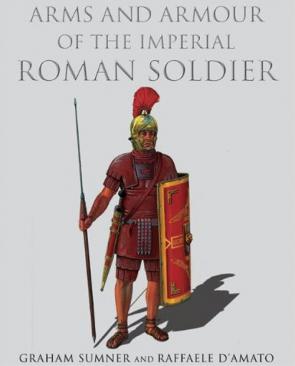
A Roman soldier wore armour made from strips of iron and leather (lorica segmentata in Latin). On his head was a metal helmet (galea). He carried a rectangular shield (scutum), curved so it protected his body. The shield was made of wood and leather.
The soldier's main weapons were a short sword for stabbing (gladius) and a long spear, or javelin (pilum) for throwing. The javelin had a sharp iron point, and a thin, bendy shaft. When it hit an enemy's shield, the point stuck in, but the shaft bent. This made it difficult to pull out. The long spear shaft got in the way, so the enemy soldier had to throw away his shield.

How well-trained were Roman soldiers?

Roman soldiers kept fit by running, marching and practice-fighting. They could march 20 miles (30 km) a day wearing armour. They could swim or cross rivers in boats, build bridges, and smash their way into forts. Each man carried his weapons and shield, some food and camping equipment (such as spare clothes, cooking pot and an axe or spade).
Roman soldiers almost always obeyed orders. They usually fought in lines, marching forward with their shields facing the enemy. If they were being fired at from above (with arrows or rocks), the men would lift their shields over their heads for protection. They looked like a tortoise, so they called this formation the testudo (Latin for tortoise).


Useful Sites:

http://www.bbc.co.uk/schools/primaryhistory/romans/the_roman_army/

http://www.history.org.uk/resources/resource_2943.html

http://www.schoolsliaison.org.uk/kids/access/rome/artefacts_rome.htm

http://rome.mrdonn.org/index.html


Sunday, March 3, 2013

The 12 Tables of Rome


The twelve tables of Rome were the laws of Rome and the foundation for their first written constitution. They outline the basic human rights and create mandates for different situations some bad, some good. The twelve tables were written by and for the two classes of people in Rome at the time,the Patricians and the Plebeians. The Patricians were the upper class, lawmaking, voting, landowning, and ruling people of Rome, they wanted the twelve tables mostly to keep the Plebeians in check and in their own class. The Plebeians were the lower class workers, farmers, ect... Most of the 6th century B.C. was ruled by the Patricians who made laws to keep themselves rich and in power and the Plebeians suffered from this. The plebeians were upset with the current system of laws, they were willing to secede from Rome if they were given an alternative. By the 5th century B.C. they had come to an agreement on the twelve tables.
external image 62007124_31130f2bf4.jpg?v=0external image 12-tables.png?w=288&h=353
These laws talked about property, crime, family, theft, marriage and inheritance.The laws tried to be fair on most accounts. These were the first laws written down. They were engraved on stone tablets and put on display at the Forum in the city of Rome, so that everyone could see them and know the laws of Rome. This is assumed to have helped their crime rates and made Rome a better place.
external image 12tables.jpg
The twelve laws that they had decided on were as follows:
Table I: If a person is summoned to a court, they must go, or they will be taken. If they run they will be captured.
Table II: If a judge or a member of either side is taken ill, or must meet and enemy, etc... The Precedings must end or be postponed.
Table III: A person in debt has 30 days to pay off the debt or the debtor may take the debt back..
Table IV: A child that is born to a deformity must be put to death. any son who is sold by his father into slavery three times may be free from that father.
Table V: If a person dies without a will the nearest male kinsman may inherit their belongings. If a person goes mad, the nearest male kinsman may take their belongings and responsibility for the person.
Table VI: If someone says something is theirs orally, it is theirs. No one is allowed to displace a beam from a building or a vineyard.
Table VII: Property owners are responsible for their own roads where there is right of way, and if it is not kept, people may go where they please.
Table VIII: If someone breaks another mans hand he must pay 300, slaves 150, if a man kills another mans crops he must pay...if you cause injury accidentally, you owe a ram
Table IX: A judge shall be put to death if he is found taking a bribe. A person committing treason shall be put to death.
Table X: No man shall be cremated within a city.
Table XI: marriage between Plabeians and Patricians is prohibited.
Table XII: If a person gives false witness they shall be thrown from the Tarpeian rock

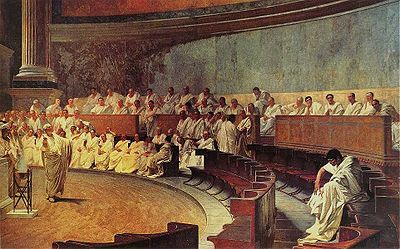
external image maccari-cicero.jpg


http://romanhistoryhour7.wikispaces.com/1.+2000+BCE+to+450+BCE

Saturday, March 2, 2013

Government under the Roman Republic


Structure of Government Under the Republic

2 Consuls
Head of Government
Senate (300 members)
Assembly

PATRICIANS
PATRICIANS
PLEBEIANS
1 year term
Life term
Consuls chose the Senators
 
Elected the 2 Consuls
Ran the government, overseeing the work of other government officials.
Advised the consuls. Advised the Assembly.
Elected government officials including judges. 
Directed (commanded) the army
Directed spending, including tax dollars
 
 
Acted as judges
Approved or disapproved laws made by the Assembly
Voted on laws suggested by government officials
In an emergency, consuls could choose a dictator – a single ruler to make quick decisions.
Made decisions concerning relationships with foreign powers
Declared war or peace
Both consuls had to agree on their decisions. Each had the power to Veto the other. In Latin, veto means “I forbid.” 


http://rome.mrdonn.org/senate.html


Thursday, February 21, 2013

The tempeles werevery bad after the war.
It seemmed that they made rome look very similaras before in the video.
I learned that the king liked to watch the fight.
I think the romans were very violent and intelegent.

Saturday, February 16, 2013

Roman Gods Family Tree


Gaea & Uranus
(started the world)
Their son: Saturn

Saturn's 6 kids: 
3 girls:  Ceres, Vesta, Juno
3 boys: Neptune, Pluto, Jupiter

                                                       Saturn's grandkids
                                           (some of them)
 

Apollo, Diana, Mars, Mercury, Minerva, Proserpine,Vulcan, Hercules, Venus.


Source:http://rome.mrdonn.org/romangods/familytree.html

Wednesday, February 13, 2013

Timeline


Source: Ancient Rome Activity Book (Hands-On Heritage),Edupress.

Sunday, February 10, 2013

Students' Observations


After watching the video which showed a reconstruction of Ancient Rome, what did you observe and what caught your attention?

Friday, January 25, 2013