Saturday, March 19, 2016

Types of Gladiators
|

Types of Gladiators
http://www.tribunesandtriumphs.org/gladiators/types-of-gladiators.htm
|
Friday, March 18, 2016
WARS AND BATTLES
The Ancient Romans fought many battles and wars in order to expand and protect their empire. There were also civil wars where Romans fought Romans in order to gain power. Here are some of the major battles and wars that the Romans fought.
The Punic Wars
The Punic Wars were fought between Rome and Carthage from 264 BC to 146 BC. Carthage was a large City located on the coast of North Africa. This sounds like a long way away at first, but Carthage was just a short sea voyage from Rome across the Mediterranean Sea. Both cities were major powers at the time and both were expanding their empires. As the empires grew, they began to clash and soon war had begun.
There were three major parts of the Punic wars and they were fought over the course of more than 100 years,
In this battle the Roman Legion under Titus Flamininus soundly defeated the Macedonian Army led by Philip V. This battle was important because the successors of Greek leader Alexander the Great had now been defeated. Rome had become the dominant world power.
Third Servile War (73 - 71 BC)
This war started when 78 gladiators, including their leader Spartacus, escaped and started a rebellion. Soon they had over 120,000 escaped slaves and others traveling with them invading the countryside. They successfully fought back many Roman soldiers until finally an army with a full 8 legions was dispatched to destroy them. The fighting was long and bitter, but eventually Spartacus' army was defeated.
Caesar's Civil War (49 - 45 BC)
This war is also called the Great Roman Civil War. Julius Caesar's legions fought against the Senate supported legions of Pompey the Great. The war lasted for four years until Caesar finally defeated Pompey and became Dictator of Rome. This signaled the end of the Roman Republic.
The famous moment in this war was when Caesar crossed the Rubicon River. This meant he was going to war against Rome. Today the term "crossing the Rubicon" is still used to say that someone had reached the point of no return and can not go back.
The Battle of Actium (31 BC)
In this battle Octavian's forces, led by Marcus Agrippa, defeated the combined forces of Roman general Marc Antony and Egyptian Pharaoh Cleopatra VII. As a result Octavian became the sole power in Rome and would soon become Rome's first Emperor. He would change his name to Augustus when he became emperor.

http://www.ducksters.com/history/ancient_roman_wars_battles.php
The Punic Wars
The Punic Wars were fought between Rome and Carthage from 264 BC to 146 BC. Carthage was a large City located on the coast of North Africa. This sounds like a long way away at first, but Carthage was just a short sea voyage from Rome across the Mediterranean Sea. Both cities were major powers at the time and both were expanding their empires. As the empires grew, they began to clash and soon war had begun.
There were three major parts of the Punic wars and they were fought over the course of more than 100 years,
- First Punic War (264 - 241 BC): The First Punic War was fought largely over the island of Sicily. This meant a lot of the fighting was at sea where Carthage had the advantage of a much stronger navy than Rome. However, Rome quickly built up a large navy of over 100 ships. Rome also invented the corvus, a type of assault bridge that allowed Rome's superior soldiers to board enemy navy vessels. Rome soon dominated Carthage and won the war.
- Second Punic War (218 - 201 BC): In the Second Punic War, Carthage had more success fighting against the Roman legions. The Carthage leader and general, Hannibal, made a daring crossing of the Alps to attack Rome and northern Italy. This crossing was made more famous because he also brought a large number of elephants with him. Hannibal was a brilliant general and won several battles against the Romans. However, despite fighting for 16 years, Hannibal wasn't able to conquer the city of Rome. When Rome counterattacked his homeland of Carthage, Hannibal was forced to retreat. The final battle in this war was the Battle of Zama where the Roman general Scipio Africanus defeated Hannibal.
- Third Punic War (149 - 146 BC): In the Third Punic War Rome attacked the city of Carthage. After three years of laying siege to the city, the Roman army broke through the walls and burned it to the ground.
In this battle the Roman Legion under Titus Flamininus soundly defeated the Macedonian Army led by Philip V. This battle was important because the successors of Greek leader Alexander the Great had now been defeated. Rome had become the dominant world power.
Third Servile War (73 - 71 BC)
This war started when 78 gladiators, including their leader Spartacus, escaped and started a rebellion. Soon they had over 120,000 escaped slaves and others traveling with them invading the countryside. They successfully fought back many Roman soldiers until finally an army with a full 8 legions was dispatched to destroy them. The fighting was long and bitter, but eventually Spartacus' army was defeated.
Caesar's Civil War (49 - 45 BC)
This war is also called the Great Roman Civil War. Julius Caesar's legions fought against the Senate supported legions of Pompey the Great. The war lasted for four years until Caesar finally defeated Pompey and became Dictator of Rome. This signaled the end of the Roman Republic.
The famous moment in this war was when Caesar crossed the Rubicon River. This meant he was going to war against Rome. Today the term "crossing the Rubicon" is still used to say that someone had reached the point of no return and can not go back.
The Battle of Actium (31 BC)
In this battle Octavian's forces, led by Marcus Agrippa, defeated the combined forces of Roman general Marc Antony and Egyptian Pharaoh Cleopatra VII. As a result Octavian became the sole power in Rome and would soon become Rome's first Emperor. He would change his name to Augustus when he became emperor.
http://www.ducksters.com/history/ancient_roman_wars_battles.php
Who was in the Roman army?
- Only men could be in the Roman Army. No women. Every Roman soldier was a Roman citizen. He had to be at least 20 years old. He was not supposed to get married while he was a soldier. Most soldiers in the Roman Empirecame from countries outside Italy. There were Roman soldiers from Africa, France, Germany, the Balkans, Spain and the Middle East.Soldiers had to stay in the army for at least 25 years! Then they could retire, with a pension or a gift of land to farm. Old soldiers often settled down to old age together, in a military town or colonia.
What was a legion?
There were about 30 legions in the Roman army. Each legion had between 4,000 and 6,000 soldiers, called legionaries. Each legion had ten cohorts. Each cohort was made up of six troops of about 80 legionaries, called centuries. Each century was led by a centurion. A centurion carried a short rod, to show his importance. He could also use his stick to beat any soldier who disobeyed an order. The officer commanding the whole legion was called a legate.What other soldiers did the Romans have?
Legionaries were the best Roman soldiers, and the best paid. There were other soldiers though. An auxiliary was a soldier who was not a Roman citizen. He was paid a third as much as a legionary. Auxiliaries guarded forts and frontiers, but also fought in battles, often in the front lines, where it was the most dangerous.Some soldiers had special skills. They shot bows and arrows, flung stones from slingshots, or could swim rivers to surprise an enemy - like modern commandos.Artillery soldiers fired giant catapults, called onagers in Latin, machines that fired rocks or balls of burning tar. The Romans used big wind-up crossbows, called ballistas in Latin, too.Usually, Romans liked to fight on foot. They used cavalry (soldiers riding horses) to chase a fleeing enemy. In a battle, the cavalry often lined up either side of the infantry (foot-soldiers).What armour and weapons did the Romans have?
We know about Roman armour and weapons from Roman pictures and statues, and from finds by modern archaeologists.A Roman soldier wore armour made from strips of iron and leather (lorica segmentata in Latin). On his head was a metal helmet (galea). He carried a rectangular shield (scutum), curved so it protected his body. The shield was made of wood and leather.The soldier's main weapons were a short sword for stabbing (gladius) and a long spear, or javelin (pilum) for throwing. The javelin had a sharp iron point, and a thin, bendy shaft. When it hit an enemy's shield, the point stuck in, but the shaft bent. This made it difficult to pull out. The long spear shaft got in the way, so the enemy soldier had to throw away his shield.How well-trained were Roman soldiers?
Roman soldiers kept fit by running, marching and practice-fighting. They could march 20 miles (30 km) a day wearing armour. They could swim or cross rivers in boats, build bridges, and smash their way into forts. Each man carried his weapons and shield, some food and camping equipment (such as spare clothes, cooking pot and an axe or spade).Roman soldiers almost always obeyed orders. They usually fought in lines, marching forward with their shields facing the enemy. If they were being fired at from above (with arrows or rocks), the men would lift their shields over their heads for protection. They looked like a tortoise, so they called this formation the testudo (Latin for tortoise).- http://www.bbc.co.uk/schools/primaryhistory/romans/the_roman_army/

Free Time
Did the Romans have free time?
Most people in Roman times did not have much spare time. They were too busy working. They liked games though. Soldiers often played board games with counters and dice. Counters and boards for their games have been found. Archaeologists aren't always sure of the rules!Hunting was also popular. People hunted animals for fun as well as for food. The Romans introduced fallow deer to Britain, just for hunting.Some things the Romans did for fun were horrible. They enjoyed fights between gladiators, and fights between people and animals. These bloodthirsty shows were put on in front of crowds in large arenas called amphitheatres.Roman emperors paid for free shows at theatres and amphitheatres. It was a good way to make themselves popular.
What did gladiators do?
Gladiators fought one another, usually in pairs. They also fought wild animals such as lions or bears. When a gladiator was beaten (but still alive), the audience would wave scarves or put their thumbs out if they wanted him killed. If he'd fought well, and they wanted him to live, they would close their thumbs onto their fingers. Different types of gladiators used different weapons. For example, a man with a sword and shield might fight a man with a three-pronged spear or trident, and a big net.
Theatre
Romans enjoyed the theatre. Most plays were funny comedies, though there were serious tragedies as well. Actors often wore masks to show whether their character was happy or sad! They also wore wigs - an old man had a white wig, a slave had a red wig.
Why did Romans like baths so much?
Roman baths were like leisure centres. You went there to relax, not just to get clean. The baths were open to everyone, and a good place to keep fit, meet people and do business.
When you went to the baths, you took off your outdoor clothes and warmed up with some exercises. Then, after a swim in the pool, you went into a series of heated rooms. You got hotter and hotter, to sweat out the dirt. You'd chat with friends while you sweated, and perhaps have a massage and rub down with perfumed oil. Then you (or a slave) would scrape off the dirt, sweat and oil with a metal scraper called a strigil. Finally, a plunge into a cold pool. Very refreshing! The best preserved Roman baths in Britain are in the city of Bath.
What happened in a chariot race?
In Rome there was a huge stadium called the Circus Maximus, used forchariot races. Chariot races were held in Britain too. These were thrilling, but very dangerous. Chariots were small two-wheeled carts, driven by one man and pulled by four galloping horses. They raced around an oval track. There were often smashes during the seven-lap races.
http://www.bbc.co.uk/schools/primaryhistory/romans/leisure/
Saturday, March 12, 2016
Engineering and Construction
The Romans put a great deal of effort into engineering. Roman engineering led to the building of some remarkable engineering feats that have survived to this day throughout western Europe like roads, theatres, baths or Hadrian's Wall. Engineering was used as a way of improving the lifestyle of the Romans even on day-to-day issues such as a frequent water supply.
Roman engineering had a large influence on Roman architecture. Arches were used a lot due to their strength. The Romans also used domes as they enabled them to build large ceilings with wide open spaces.
All Roads Lead To Rome
Rome made a great deal of money from trade in Europe. Some of this trade involved transport by sea. More frequently, the Romans used roads. Also with so much of Western Europe conquered by the Romans, the Romans needed roads to move their troops around quickly. Poorly built roads would not help this.


The roads were designed to last despite the environment. They were built using many layers of masonry including concrete. These durable roads are still used today. They were also built with a hump making water flow to the edges. This kept the roads from flooding and allowed them to be used in rainy weather.
Water Supply
Aqueducts were long channels that the Romans built to carry water into the cities. Many of the Roman aqueducts were below ground. The water that was carried into the cities was used for drinking water, baths, and sewers. It was generally carried to a public fountain where people could then use buckets to get their water. Roman plumbing became so advanced that many of the large wealthy houses had running water.

The Roman Baths
One of the characteristic Imperial Roman building types is the giant bath complex which could house not only bathing facilities but lecture halls, gymnasia, libraries and gardens.Roman baths were more like a visit to a leisure centre than a quick scrub. The Romans loved the baths because they were a good place to meet people and business could be conducted there.
When you went to the baths you firstly changed out of your clothes and did some exercises. Then you might have a swim in the pool before going into a series of rooms which got hotter and hotter to help make you sweat off the dirt.
When the Romans were in these rooms they would often stop and talk to each other. All the dirt and sweat was then scraped off with a strigil and you had a swim in the cold pool.
Roman Sanitation
The Romans also invented the best drains in the world. Towns and forts had underground drains to take away dirty water and sewage. They were flushed through with water from the baths so that they didn't get too smelly.
Fresh clean water and sewers are important because without them people often catch diseases from drinking dirty water or from sewage left around the streets and houses.
 |
Public Toilets, Ostia, first century BC |
The Romans were good at building and engineering, but not so good at inventing machines. There were always plenty of slaves to do the nasty jobs, so nobody bothered to think up machines that could take their place. An example of this was central heating which involved lots of effort from Roman slaves. Public baths and rich people's houses all had central heating.
Houses were also centrally heated by what was known as a hypocaust. This was under-floor heating. Slaves were charged with keeping the hypocaust both clean and alight during the day. This system of heating was also used to keep some Roman baths hot.


Running Water for the Wealthy
Houses also had water piped straight to them - unlike flats and apartments. Lead pipes brought water to a house. However, these pipes were taxed according to size - the larger the pipes, the more the tax. Archaeologists can usually tell the wealth of an owner of a Roman house by simply looking at the size of the lead pipes that brought water to that house.

Bridges
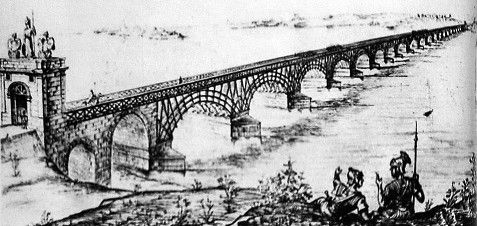
The Romans built long durable bridges. Many of their bridges still stand today. They used stone and concrete to build their bridges and used the arch as the basic architectural feature to make them strong. The largest Roman bridge ever built was the Trajan bridge over the river Danube. It was over 3700 feet long and 62 feet high.
The Colosseum
The Colosseum in Rome is a great example of Roman engineering and construction. The Colosseum was a large outdoor stadium that could seat around 50,000 people for various forms of entertainment such as gladiator games, mock battles, and dramas. The huge Colosseum is free standing and built with multiple arches to give it strength. Much of it still stands today, although earthquakes have knocked portions of it down. It is 615 feet long and 510 feet wide and took around 131,000 cubic yards of stone to make.
The Pantheon
 | The Pantheon at Rome was built by Agrippa in 27 BC, destroyed, and rebuilt in the 2d cent. by Hadrian. Remarkably well preserved, it is mainly of brick with a great hemispherical dome whose supporting walls are set in concrete. |
Fun Facts about Roman Engineering
- The Romans built over 400,000 km of roads including 29 highways that lead to the city of Rome.
- The Latin word for road is via. The plural of via is viae. Roman roads generally had the name via in them, like the Via Appia or the Via Flaminia.
- All the aqueducts in the city of Rome together totaled around 500 miles in length.
- The Romans were among the first civilizations to harness water power.
- It is estimated that the Romans built over 900 bridges in their empire.
http://www.angelfire.com/hi5/interactive_learning/romanbuildingfiles/yr_7_roman_builbing.htm
http://www.ducksters.com/history/ancient_roman_engineering.php
Subscribe to:
Posts (Atom)