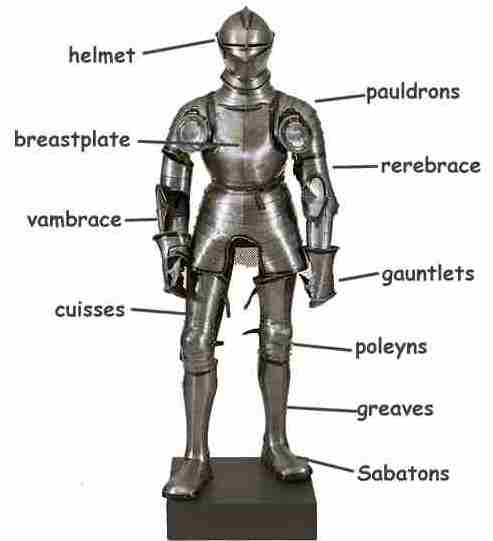
♦ Armor – the protective clothing, weapons, and shield worn by a knight
♦ Caravan – a group traveling together
♦ Castle – home to the king and the place of safety for the manor
♦ Chivalry – the rules of behavior followed by the knights during the Middle
Ages
♦ Coat of arms – the symbol used to identify members of a noble family, usually placed
on shields and homes
♦ Crusader – a Christian soldier who fought to free the Holy Land from Muslims in the
Middle Ages
♦ Cuneiform –wedge-shaped marks that represent sounds, and could be combined to
form words used mainly by the Sumerians
♦ Feudalism – the system of protection and loyalties in the Middle Ages
♦ Guild – a group organized by merchants and craft workers to protect members and set
standards of quality
♦ Hieroglyphics – writing using pictures to represent events or sounds, had a more
highly developed phonetic element than earlier written communications
♦ Illuminations – designs, pictures, and decorations added to manuscripts to make them
draw the reader into the story
♦ Invader – outsiders fighting to take over an area
♦ King – the ruler of the land, the top position in the feudal government
♦ Knight – a trained, armored horseman who fought wars in the Middle Ages, always
noble by birth
♦ Longship – a low, lightweight, sleek ship built by the Vikings which greatly impacted
transportation during the Middle Ages
♦
♦ Lord – the second in order in the feudal government, owned less land than the king
and therefore was loyal to the king
♦ Magnetic compass – a tool with a magnetized needle used to determine direction for
navigation
♦ Manor – a large estate or farm belonging to a noble family, the home area for all who
owned, worked on, or belonged to the land
♦ Middle Ages – the time between 400 and 1400 AD
♦ Moat – a large, deep ditch surrounding the castle as a defense against attack,
sometimes filled with water
♦ Nobles – a member of the wealthiest class in feudal society
♦ Page – a young noble boy who carried messages and waited on the lord
♦ Peasant –a poor but free person who lives on and farms the land in exchange for
protection
♦ Pictograph –a drawing or symbol used to represent events
♦ Roman Roads – a network of reads built in Rome during the Roman Empire, used
primarily for military purposes
♦ Seal – a symbolic representation of a family’s nobility and linage
♦ Serf – a poor person who lives on and farms the land, they are not free, but belong to
the land
♦ Signet ring – a ring containing a small engraved family seal
♦ Squire – a noble boy who is a servant to the knight as he is learning to be a knight
♦ Tapestry – heavy cloth woven with designs usually telling a story, hung on the walls
during the Middle Ages
♦ Timeline – a diagram of a certain period of time with important events marked
♦ Tithe – one tenth of your income or crops
♦ Trade – the exchange of goods
♦ Vassal – in the Middle Ages, one who served a lord in exchange for land
♦ Vikings – pirates from northern Europe who invaded and stole from the villages
along the coasts of Europe during the 8th to 10th centuries
http://www.beaconlearningcenter.com/documents/1048_3403.pdf