Sunday, March 17, 2013
Free Time
Did the Romans have free time?
Most people in Roman times did not have much spare time. They were too busy working. They liked games though. Soldiers often played board games with counters and dice. Counters and boards for their games have been found. Archaeologists aren't always sure of the rules!
Hunting was also popular. People hunted animals for fun as well as for food. The Romans introduced fallow deer to Britain, just for hunting.
Some things the Romans did for fun were horrible. They enjoyed fights between gladiators, and fights between people and animals. These bloodthirsty shows were put on in front of crowds in large arenas called amphitheatres.
Roman emperors paid for free shows at theatres and amphitheatres. It was a good way to make themselves popular.
What was a Roman play like?
Romans enjoyed the theatre. Most plays were funny comedies, though there were serious tragedies as well. Actors often wore masks to show whether their character was happy or sad! They also wore wigs - an old man had a white wig, a slave had a red wig.
Why did Romans like baths so much?
Roman baths were like leisure centres. You went there to relax, not just to get clean. The baths were open to everyone, and a good place to keep fit, meet people and do business.
When you went to the baths, you took off your outdoor clothes and warmed up with some exercises. Then, after a swim in the pool, you went into a series of heated rooms. You got hotter and hotter, to sweat out the dirt. You'd chat with friends while you sweated, and perhaps have a massage and rub down with perfumed oil. Then you (or a slave) would scrape off the dirt, sweat and oil with a metal scraper called a strigil. Finally, a plunge into a cold pool. Very refreshing! The best preserved Roman baths in Britain are in the city of Bath.
What happened in a chariot race?
In Rome there was a huge stadium called the Circus Maximus, used for chariot races. Chariot races were held in Britain too. These were thrilling, but very dangerous. Chariots were small two-wheeled carts, driven by one man and pulled by four galloping horses. They raced around an oval track. There were often smashes during the seven-lap races.
http://www.bbc.co.uk/schools/primaryhistory/romans/leisure/

Thursday, March 14, 2013
Hercules
Hercules was the god of war.His mother was mortal but his dad was a god.His dad Jupiter had a wife called Juno and she was very jealous because Jupter liked more Hercules so she put snakes to kill him, but he killd all the snakes with his hands,[dont forget he was a baby].
Victor M.
Sunday, March 10, 2013

The Roman Army
Who was in the Roman army?
Only men could be in the Roman Army. No women. Every Roman soldier was a Roman citizen. He had to be at least 20 years old. He was not supposed to get married while he was a soldier. Most soldiers in the Roman Empire came from countries outside Italy. There were Roman soldiers from Africa, France, Germany, the Balkans, Spain and the Middle East.Soldiers had to stay in the army for at least 25 years! Then they could retire, with a pension or a gift of land to farm. Old soldiers often settled down to old age together, in a military town or colonia.
What was a legion?
There were about 30 legions in the Roman army. Each legion had between 4,000 and 6,000 soldiers, called legionaries. Each legion had ten cohorts. Each cohort was made up of six troops of about 80 legionaries, called centuries. Each century was led by a centurion. A centurion carried a short rod, to show his importance. He could also use his stick to beat any soldier who disobeyed an order. The officer commanding the whole legion was called a legate.What other soldiers did the Romans have?
Legionaries were the best Roman soldiers, and the best paid. There were other soldiers though. An auxiliary was a soldier who was not a Roman citizen. He was paid a third as much as a legionary. Auxiliaries guarded forts and frontiers, but also fought in battles, often in the front lines, where it was the most dangerous.Some soldiers had special skills. They shot bows and arrows, flung stones from slingshots, or could swim rivers to surprise an enemy - like modern commandos.
Artillery soldiers fired giant catapults, called onagers in Latin, machines that fired rocks or balls of burning tar. The Romans used big wind-up crossbows, called ballistas in Latin, too.
Usually, Romans liked to fight on foot. They used cavalry (soldiers riding horses) to chase a fleeing enemy. In a battle, the cavalry often lined up either side of the infantry (foot-soldiers).
What armour and weapons did the Romans have?
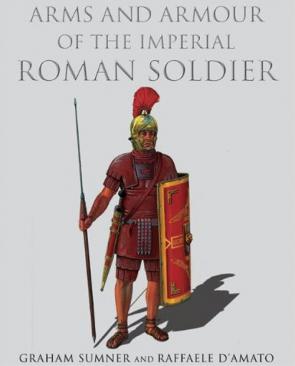
We know about Roman armour and weapons from Roman pictures and statues, and from finds by modern archaeologists.A Roman soldier wore armour made from strips of iron and leather (lorica segmentata in Latin). On his head was a metal helmet (galea). He carried a rectangular shield (scutum), curved so it protected his body. The shield was made of wood and leather.
The soldier's main weapons were a short sword for stabbing (gladius) and a long spear, or javelin (pilum) for throwing. The javelin had a sharp iron point, and a thin, bendy shaft. When it hit an enemy's shield, the point stuck in, but the shaft bent. This made it difficult to pull out. The long spear shaft got in the way, so the enemy soldier had to throw away his shield.
How well-trained were Roman soldiers?
Roman soldiers kept fit by running, marching and practice-fighting. They could march 20 miles (30 km) a day wearing armour. They could swim or cross rivers in boats, build bridges, and smash their way into forts. Each man carried his weapons and shield, some food and camping equipment (such as spare clothes, cooking pot and an axe or spade).Roman soldiers almost always obeyed orders. They usually fought in lines, marching forward with their shields facing the enemy. If they were being fired at from above (with arrows or rocks), the men would lift their shields over their heads for protection. They looked like a tortoise, so they called this formation the testudo (Latin for tortoise).
Useful Sites:
http://www.bbc.co.uk/schools/primaryhistory/romans/the_roman_army/
http://www.history.org.uk/resources/resource_2943.html
http://www.schoolsliaison.org.uk/kids/access/rome/artefacts_rome.htm
http://rome.mrdonn.org/index.html
Sunday, March 3, 2013
The 12 Tables of Rome
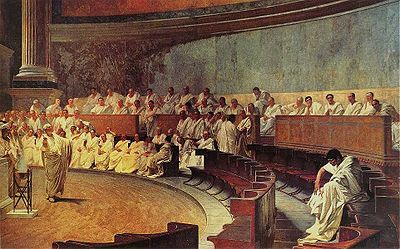
The twelve tables of Rome were the laws of Rome and the foundation for their first written constitution. They outline the basic human rights and create mandates for different situations some bad, some good. The twelve tables were written by and for the two classes of people in Rome at the time,the Patricians and the Plebeians. The Patricians were the upper class, lawmaking, voting, landowning, and ruling people of Rome, they wanted the twelve tables mostly to keep the Plebeians in check and in their own class. The Plebeians were the lower class workers, farmers, ect... Most of the 6th century B.C. was ruled by the Patricians who made laws to keep themselves rich and in power and the Plebeians suffered from this. The plebeians were upset with the current system of laws, they were willing to secede from Rome if they were given an alternative. By the 5th century B.C. they had come to an agreement on the twelve tables.


These laws talked about property, crime, family, theft, marriage and inheritance.The laws tried to be fair on most accounts. These were the first laws written down. They were engraved on stone tablets and put on display at the Forum in the city of Rome, so that everyone could see them and know the laws of Rome. This is assumed to have helped their crime rates and made Rome a better place.

The twelve laws that they had decided on were as follows:
Table I: If a person is summoned to a court, they must go, or they will be taken. If they run they will be captured.
Table II: If a judge or a member of either side is taken ill, or must meet and enemy, etc... The Precedings must end or be postponed.
Table III: A person in debt has 30 days to pay off the debt or the debtor may take the debt back..
Table IV: A child that is born to a deformity must be put to death. any son who is sold by his father into slavery three times may be free from that father.
Table V: If a person dies without a will the nearest male kinsman may inherit their belongings. If a person goes mad, the nearest male kinsman may take their belongings and responsibility for the person.
Table VI: If someone says something is theirs orally, it is theirs. No one is allowed to displace a beam from a building or a vineyard.
Table VII: Property owners are responsible for their own roads where there is right of way, and if it is not kept, people may go where they please.
Table VIII: If someone breaks another mans hand he must pay 300, slaves 150, if a man kills another mans crops he must pay...if you cause injury accidentally, you owe a ram
Table IX: A judge shall be put to death if he is found taking a bribe. A person committing treason shall be put to death.
Table X: No man shall be cremated within a city.
Table XI: marriage between Plabeians and Patricians is prohibited.
Table XII: If a person gives false witness they shall be thrown from the Tarpeian rock
http://romanhistoryhour7.wikispaces.com/1.+2000+BCE+to+450+BCE
Saturday, March 2, 2013
Government under the Roman Republic
Structure of Government Under the Republic
|
2
Consuls
Head of Government |
Senate
(300 members)
|
Assembly
|
|
PATRICIANS
|
PATRICIANS
|
PLEBEIANS
|
|
1
year term
|
Life
term
|
|
|
Consuls
chose the Senators
|
|
Elected
the 2 Consuls
|
|
Ran
the government, overseeing the work of other government officials.
|
Advised
the consuls. Advised the Assembly.
|
Elected
government officials including judges.
|
|
Directed
(commanded) the army
|
Directed
spending, including tax dollars
|
|
|
Acted
as judges
|
Approved
or disapproved laws made by the Assembly
|
Voted
on laws suggested by government officials
|
|
In
an emergency, consuls could choose a dictator – a single ruler to
make quick decisions.
|
Made
decisions concerning relationships with foreign powers
|
Declared
war or peace
|
|
Both
consuls had to agree on their decisions. Each had the power to Veto
the other. In Latin, veto means “I forbid.”
|
|
Subscribe to:
Posts (Atom)