Total Pageviews

Friday, August 19, 2016

The Silk Road

The Silk Road was a trade route that went from China to Eastern Europe. It went along the northern borders of China, India, and Persia and ended up in Eastern Europe near today's Turkey and the Mediterranean Sea. 

Silk road
Map of the Silk Road - Route in red (later ocean routes in blue)


Why was the Silk Road important? 

The Silk Road was important because it helped to generate trade and commerce between a number of different kingdoms and empires. This helped for ideas, culture, inventions, and unique products to spread across much of the settled world. 

Why is it called the Silk Road? 

It was called the Silk Road because one of the major products traded was silk cloth from China. People throughout Asia and Europe prized Chinese silk for its softness and luxury. The Chinese sold silk for thousands of years and even the Romans called China the "land of silk". 

What goods did the Chinese trade? 

Besides silk, the Chinese also exported (sold) teas, salt, sugar, porcelain, and spices. Most of what was traded was expensive luxury goods. This was because it was a long trip and merchants didn't have a lot of room for goods. They imported, or bought, goods like cotton, ivory, wool, gold, and silver.

How did they travel? 

Merchants and tradesmen traveled in large caravans. They would have many guards with them. Traveling in a big group like a caravan helped in defending from bandits. Camels were popular animals for transport because much of the road was through dry and harsh land. 

History 

Although there was some trade between China and the rest of the world for some time, the silk trade was significantly expanded and promoted by the Han Dynasty which ruled from 206 BC to 220 AD. 

Later, under the rule of the Yuan Dynasty set up by Kublai Khan of the Mongols, trade from China along the Silk Road would reach its peak. During this time the Mongols controlled a significant portion of the trade route, enabling Chinese merchants to travel safely. Also, merchants were granted more social status during the Mongol rule. 

Fun facts about the Silk Road
  • It was over 4,000 miles long.
  • Marco Polo traveled to China along the Silk Road.
  • Not all that was traded along the Silk Road was good. It is thought that the bubonic plague, or Black Death, traveled to Europe from the Silk Road.
  • Very few merchants traveled along the entire route. Goods were traded at many cities and trade posts along the way.
  • There wasn't just one route, but many routes. Some were shorter, but more dangerous. Others took longer, but were safer.

Tuesday, August 2, 2016

Factors for a Successful Civilization

Civilizations need:

1.Education,


2. Water,

3. Communities,


4. Workforce,


5. Army and leadership,


6. Religion,


7. Language,


8. Healthy population,


9. Employment opportunities,  

10.Agriculture.


Age of Exploration - A Short Documentary Film

Why Do People Move to New Places?


In order to prepare for our next dialogue circle, discuss the following questions with your parents:

1. Why do people move to new places, cities or countries?

2. Why do Brazilians leave the country?

3. What forces people to leave their own countries?

4. Is there anything on the news at the moment regarding this topic?

5. How do we choose the best place to move to?


Friday, June 3, 2016

Fall of Rome


http://www.history.com/topics/ancient-history/ancient-rome/videos/the-fall-of-rome (VIDEO TO WATCH)

                           Study Notes in the site below

http://studyhallsuis.weebly.com/roman-army--roman-empire.html


The Fall of Rome

Rome ruled much of Europe around the Mediterranean for over 1000 years. However, the inner workings of the Roman Empire began to decline starting around 200 AD. By 400 AD Rome was struggling under the weight of its giant empire. The city of Rome finally fell in 476 AD. 

The Peak of Roman Power 

Rome reached its peak of power in the 2nd century around the year 117 AD under the rule of the great Roman emperor Trajan. Virtually all of the coastline along the Mediterranean Sea was part of the Roman Empire. This included Spain, Italy, France, southern Britain, Turkey, Israel, Egypt, and northern Africa. 

Gradual Decline 

The Fall of Rome didn't happen in a day, it happened over a long period of time. There are a number of reasons why the empire began to fail. Here are some of the causes of the fall of the Roman Empire:
  • The politicians and rulers of Rome became more and more corrupt
  • Infighting and civil wars within the Empire
  • Attacks from barbarian tribes outside of the empire such as the Visigoths, Huns, Franks, and Vandals.
  • The Roman army was no longer a dominant force
  • The empire became so large it was difficult to govern
Rome Divides into Two 

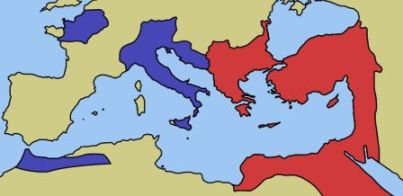
In 285 AD, Emperor Diocletian decided that the Roman Empire was too big to manage. He divided the Empire into two parts, the Eastern Roman Empire and the Western Roman Empire. Over the next hundred years or so, Rome would be reunited, split into three parts, and split in two again. Finally, in 395 AD, the empire was split into two for good. The Western Empire was ruled by Rome, the Eastern Empire was ruled by Constantinople. 

Map of the Eastern and Western Roman Empire right before the fall

The "fall" of Rome discussed here is referring to the Western Roman Empire which was ruled by Rome. The Eastern Roman Empire became known as the Byzantium Empire and remained in power for another 1000 years. 

The City of Rome is Sacked 

The city of Rome was thought by many to be unconquerable. However, in 410 AD, a Germanic barbarian tribe called the Visigoths invaded the city. They looted the treasures, killed and enslaved many Romans, and destroyed many buildings. This was the first time in 800 years that the city of Rome had been sacked. 

Rome Falls 

In 476 AD, a Germanic barbarian by the name of Odoacer took control of Rome. He became king of Italy and forced the last emperor of Rome, Romulus Augustulus, to give up his crown. Many historians consider this to be the end of the Roman Empire. 

The Dark Ages Begins 

With the fall of Rome, many changes occurred throughout Europe. Rome had provided a strong government, education, and culture. Now much of Europe fell into barbarianism. The next 500 years would be known as the Dark Ages of Europe. 

Interesting Facts about the Fall of Rome
  • The Eastern Roman Empire, or Byzantium, fell in 1453 to the Ottoman Empire.
  • Many poor people were glad to see Rome fall. They were starving to death while being taxed heavily by Rome.
  • Near the end of the Roman Empire, the city of Rome was no longer the capital. The city of Mediolanum (now Milan) was capital for a while. Later, the capital was moved to Ravenna.
  • Rome was sacked once again in 455 AD by Geiseric, King of the Vandals. The Vandals were an Eastern Germanic tribe. The term "vandalism" comes from the Vandals.