Total Pageviews

Friday, June 3, 2016

The Rise and Fall of Ancient Rome

http://en.wikipedia.org/wiki/File:Roman_Republic_Empire_map_fast.gif

File:Roman Republic Empire map fast.gif


Map of the Roman Empire based on Image:BlankMap-Europe-v3.png, displayed in the map:

Reasons For the Decline of Ancient Rome

Rome - Kingdom, Republic and Empire together - lasted about 1200 years.  Rome ruled all around the Mediterranean and large sections of Europe and Southwest Asia.  Yet in the end, the problems grew too great and the Western Roman Empire fell.

                                   Why did the empire fall apart?  
There is no one single reason, but a series of problems that grew too large to solve. 

1. The empire grew too large to govern.  The Romans tried to solve this by dividing the empire.  

2. The Romans no longer wanted to serve in the army.  The Romans tried to solve this by hiring barbarians to fight for them.  

3,Civil wars broke out in Rome between different factions.  

4.The rich grew disinterested in helping Rome and only wanted more for themselves and their families.  

5.The population of Rome shrank.  

6.Trade decreased while taxes and prices increased.  The poor were overtaxed.  

7.The use of slaves put people out of work. 

The Romans were aware of these problems and sometimes, under a good emperor, they would work on them for a while.  In time, the good emperor would be gone and a bad one would take his place.  Soon the problems in the Western Roman Empire grew so great that the Western (European) Roman empire fell to barbarian tribes in Europe. 

In Europe there were five major barbarian tribes - the Huns, Franks, Vandals, Saxons, and Visigoths (Goths) - and all of them hated Rome.  Each of the barbarian tribes wanted to destroy Rome.  The Barbarians were destroying Roman towns and cities in the outer regions of the empire.   The only reason that they had not destroyed Rome yet was they spent almost as much time fighting each other as they did Rome.  
The Eastern Roman empire continued another 1000 years.

Rome Falls 

In 476 AD, a Germanic barbarian by the name of Odoacer took control of Rome. He became king of Italy and forced the last emperor of Rome, Romulus Augustulus, to give up his crown. Many historians consider this to be the end of the Roman Empire. 


Sunday, April 10, 2016

The Twelve Tables of Rome

he Twelve Tables of Ancient Rome[11]


The twelve tables of Rome were the laws of Rome and the foundation for their first written constitution. They outline the basic human rights and create mandates for different situations some bad, some good. The twelve tables were written by and for the two classes of people in Rome at the time,the Patricians and the Plebeians. The Patricians were the upper class, lawmaking, voting, landowning, and ruling people of Rome, they wanted the twelve tables mostly to keep the Plebeians in check and in their own class. The Plebeians were the lower class workers, farmers, ect... Most of the 6th century B.C. was ruled by the Patricians who made laws to keep themselves rich and in power and the Plebeians suffered from this. The plebeians were upset with the current system of laws, they were willing to secede from Rome if they were given an alternative. By the 5th century B.C. they had come to an agreement on the twelve tables.
external image 62007124_31130f2bf4.jpg?v=0external image 12-tables.png?w=288&h=353
These laws talked about property, crime, family, theft, marriage and inheritance.The laws tried to be fair on most accounts. These were the first laws written down. They were engraved on stone tablets and put on display at the Forum in the city of Rome, so that everyone could see them and know the laws of Rome. This is assumed to have helped their crime rates and made Rome a better place.

The twelve laws that they had decided on were as follows:
Table I: If a person is summoned to a court, they must go, or they will be taken. If they run they will be captured.
Table II: If a judge or a member of either side is taken ill, or must meet and enemy, etc... The Precedings must end or be postponed.
Table III: A person in debt has 30 days to pay off the debt or the debtor may take the debt back..
Table IV: A child that is born to a deformity must be put to death. any son who is sold by his father into slavery three times may be free from that father.
Table V: If a person dies without a will the nearest male kinsman may inherit their belongings. If a person goes mad, the nearest male kinsman may take their belongings and responsibility for the person.
Table VI: If someone says something is theirs orally, it is theirs. No one is allowed to displace a beam from a building or a vineyard.
Table VII: Property owners are responsible for their own roads where there is right of way, and if it is not kept, people may go where they please.
Table VIII: If someone breaks another mans hand he must pay 300, slaves 150, if a man kills another mans crops he must pay...if you cause injury accidentally, you owe a ram
Table IX: A judge shall be put to death if he is found taking a bribe. A person committing treason shall be put to death.
Table X: No man shall be cremated within a city.
Table XI: marriage between Plabeians and Patricians is prohibited.
Table XII: If a person gives false witness they shall be thrown from the Tarpeian rock

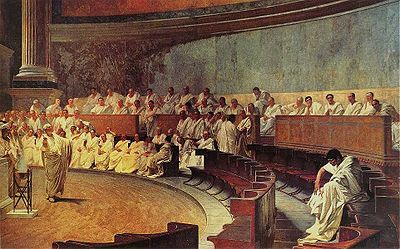
external image maccari-cicero.jpg


http://romanhistoryhour7.wikispaces.com/1.+2000+BCE+to+450+BCE

http://rome.mrdonn.org/12tables.html

Government under the Roman Republic


                          Structure of the Government 509BC


2 Consuls
Head of Government
Senate (300 members) 
Assembly 
PATRICIANS
PATRICIANS
PLEBEIANS
1 year term
Life term
Consuls chose the Senators

Elected the 2 Consuls
Ran the government, overseeing the work of other government officials.
Advised the consuls. Advised the Assembly.
Elected government officials including judges. 
Directed (commanded) the army
Directed spending, including tax dollars


Acted as judges
Approved or disapproved laws made by the Assembly
Voted on laws suggested by government officials
In an emergency, consuls could choose a dictator – a single ruler to make quick decisions.
Made decisions concerning relationships with foreign powers
Declared war or peace
Both consuls had to agree on their decisions. Each had the power to Veto the other. In Latin, veto means “I forbid.” 


http://rome.mrdonn.org/senate.html

Leasdership in Ancient Rome.


           How is power gained, used and justified?


           What kind of leadership do we have in Brazil?
                  

           Why do we have laws?


           What are the 12 Tables?


     Watch video.       

     http://www.mrdowling.com/702-patricians.html

Saturday, March 19, 2016

E.Book


Read the story

http://www.salariya.com/web_books/gladiator/index.html

Types of Gladiators

History, Facts and Information about Types of Gladiators

The content of this article provides interesting history, facts and information about different types of Gladiators. There were many different types of gladiators who were divided into different classes according to their weapons and fighting styles. There were strict rules and protocol surrounding the fights of gladiators. The pairing of the different types of gladiators was important and ironically the Romans expected to see 'fair play' in the gladiatorial combats. The selection of  'matched pairs' of different types of gladiators of would ensure that one fighter was hampered by heavy armor whilst the other was lightly armed. The different types of Gladiators have therefore been detailed on this page in four classes:
  • The Elite Types of Gladiators
  • Types of gladiators who heavily armed
  • Types of gladiators who lightly armed
  • Types of gladiators who specialised in unusual types of combat or entertainment
One type of gladiator might have freedom of movement but with little armor, or no armor to protect him. The other type of gladiator matched against him might be more heavily armed and protected but restricted in his movements by his armor.
Roman Gladiators
Roman Gladiators
Types of Gladiators - How many different Types of Gladiators fought in Ancient Rome?How many different Types of Gladiator fought in Ancient Rome? Good question but we cannot provide a definitive answer. The history of the gladiators dates back over 2000 years and much of the information about them has been lost. We have, however, provided facts and interesting information about 26 different types of gladiator including their specialised fighting skills, their opponents and their weapons, clothing, armor and shields.
Names given to different Types of GladiatorsThe first Roman Gladiators were prisoners of war and were named according to their ethnic roots such as Samnite,  Thracian and the Gaul (Gallus).  Old enemies became allies and the names of the different types of gladiators changed to reflect their combat techniques such as Secutores (chasers), Bestiarii (beast fighters) and Retiarius (net fighters).
Types of Gladiators - List of the Elite
The elite types of Gladiators were the Rudiarius who were gladiators who had obtained their freedom but chose to continue fighting in gladiatorial combats, the Tertiarius who were experienced gladiators who acted as substitutes if a gladiator was unable to fight and the Sagittarius, a rare delight for the spectators, as these were highly accomplished mounted bowmen. Each of this type of gladiator was well known to the spectators, highly experienced and extremely skilful.
Types of Gladiators - List of Heavily armed Gladiators
The different Types of Gladiators who were heavily armed were as follows:
Types of Gladiators - List of Lightly armed Gladiators
The different Types of Gladiators who were heavily armed were as follows:
List of Unusual Types of Gladiators
There were also unusual types of Gladiators. These types of gladiators were forced to fight, or specialised in, unusual types of combat or entertainment. The Andabatae (Sight Restricted Gladiators) were convicted prisoners who were forced to wear helmets without any eye holes. No other armor was worn. They fought bare-chested and blindly lashed out at each other until the last man was standing. The Bestiarii (Beast Fighters) were lightly armored types of gladiators and fought wild animals. The Venatores were Wild Animal Hunters who entertained the spectators with their hunting skills. The Praegenarii were the 'opening act gladiators'. This type of gladiator only used wooden swords, accompanied to festive music. The Bustuarii was a type of slave gladiator who fought in combats to the death at the funerals of prominent Romans. The Naumachiarii were combatants in sea-fights - the arena of the Roman Colosseum was originally able to produce such sea battles for more information see Water Battles at the Colosseum. Facts and information about all of these different, unusual types of gladiators can be accessed via the following links: 
Names of other Types of GladiatorsOther specific names were given to different types of gladiators according to their status and roles:
  • Auctorati - Definition: Roman citizens who were in debt and sold themselves to gladiator schools for money, swearing of a legal agreement agreeing to submit to beating, burning, and death by the sword if they did not perform as required. Auctorati gladiators were not deprived of their Roman citizenship
  • Tirones gladiatores or Tiro - Definition: Trainee gladiators
  • Veteranus (Veterani) - Definition: A trained gladiator and a veteran of one or more gladiatorial combats 
  • Meridiani - Definition: Lightly armed gladiators who fought in the middle of the day, after the wild beast fights
  • Ordinarii - Definition: These were the regular gladiators who fought in pairs in the ordinary way
  • Catervarii - Definition: Name given to gladiators when they did not fight in pairs, but when several fought together
  • Noxii - Definition:  Criminals who had been sentenced to death fighting as gladiators in the arena
  • Gladiatores Fiscales were maintained by the private treasury of the emperor
  • Gladiatores Postulatitii, were Gladiators of great skill, maintained by the Roman state treasury
  • Taurarii gladiators who were bullfighters
Types of Gladiators
The content of this Types of Gladiators category provides free educational details, facts and information for reference and research for schools, colleges and homework. Refer to the Colosseum Sitemap for a comprehensive search on interesting different categories containing the history, facts and information about Ancient Rome. Just like the subject of Types of Gladiators there is hardly a page of Roman history and the Romans that is not, on some way, connected to the Roman Colosseum which became a symbol of Rome, its society, culture and life.

Types of Gladiators

 Types of Gladiators

  • History, Facts and information about different types of gladiator
  • How many different Types fought in Ancient Rome?
  • Types of the Elite: Rudiarius, Tertiarius and Sagittarius
  • Types of Heavily armed : Cataphractarius, Gallus, Hoplomachi, Provocatores, Samnites, Secutores, Scissores and Thrax (Thracian)
  • Types of Lightly armed fighters: Dimachaeri, Eques, Essedari, Laquerarii, Murmillones, Paegniarius, Retiarii and Velites
  • Unusual Types of Gladiator: Andabatae, Bestiarii, Bustuarii, Naumachiarii, Praegenarii and Venatores
http://www.tribunesandtriumphs.org/gladiators/types-of-gladiators.htm