The Romans put a great deal of effort into engineering. Roman engineering led to the building of some remarkable engineering feats that have survived to this day throughout western Europe like roads, theatres, baths or Hadrian's Wall. Engineering was used as a way of improving the lifestyle of the Romans even on day-to-day issues such as a frequent water supply.
Roman engineering had a large influence on Roman architecture. Arches were used a lot due to their strength. The Romans also used domes as they enabled them to build large ceilings with wide open spaces.
All Roads Lead To Rome
Rome made a great deal of money from trade in Europe. Some of this trade involved transport by sea. More frequently, the Romans used roads. Also with so much of Western Europe conquered by the Romans, the Romans needed roads to move their troops around quickly. Poorly built roads would not help this.


The roads were designed to last despite the environment. They were built using many layers of masonry including concrete. These durable roads are still used today. They were also built with a hump making water flow to the edges. This kept the roads from flooding and allowed them to be used in rainy weather.
Water Supply
Aqueducts were long channels that the Romans built to carry water into the cities. Many of the Roman aqueducts were below ground. The water that was carried into the cities was used for drinking water, baths, and sewers. It was generally carried to a public fountain where people could then use buckets to get their water. Roman plumbing became so advanced that many of the large wealthy houses had running water.

The Roman Baths
One of the characteristic Imperial Roman building types is the giant bath complex which could house not only bathing facilities but lecture halls, gymnasia, libraries and gardens.Roman baths were more like a visit to a leisure centre than a quick scrub. The Romans loved the baths because they were a good place to meet people and business could be conducted there.
When you went to the baths you firstly changed out of your clothes and did some exercises. Then you might have a swim in the pool before going into a series of rooms which got hotter and hotter to help make you sweat off the dirt.
When the Romans were in these rooms they would often stop and talk to each other. All the dirt and sweat was then scraped off with a strigil and you had a swim in the cold pool.
Roman Sanitation
The Romans also invented the best drains in the world. Towns and forts had underground drains to take away dirty water and sewage. They were flushed through with water from the baths so that they didn't get too smelly.
Fresh clean water and sewers are important because without them people often catch diseases from drinking dirty water or from sewage left around the streets and houses.
 |
Public Toilets, Ostia, first century BC |
The Romans were good at building and engineering, but not so good at inventing machines. There were always plenty of slaves to do the nasty jobs, so nobody bothered to think up machines that could take their place. An example of this was central heating which involved lots of effort from Roman slaves. Public baths and rich people's houses all had central heating.
Houses were also centrally heated by what was known as a hypocaust. This was under-floor heating. Slaves were charged with keeping the hypocaust both clean and alight during the day. This system of heating was also used to keep some Roman baths hot.


Running Water for the Wealthy
Houses also had water piped straight to them - unlike flats and apartments. Lead pipes brought water to a house. However, these pipes were taxed according to size - the larger the pipes, the more the tax. Archaeologists can usually tell the wealth of an owner of a Roman house by simply looking at the size of the lead pipes that brought water to that house.

Bridges
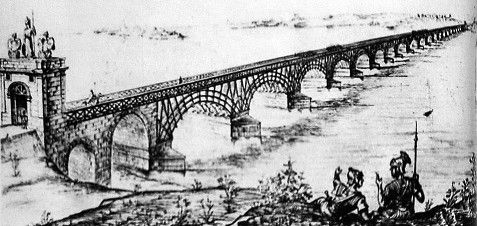
The Romans built long durable bridges. Many of their bridges still stand today. They used stone and concrete to build their bridges and used the arch as the basic architectural feature to make them strong. The largest Roman bridge ever built was the Trajan bridge over the river Danube. It was over 3700 feet long and 62 feet high.
The Colosseum
The Colosseum in Rome is a great example of Roman engineering and construction. The Colosseum was a large outdoor stadium that could seat around 50,000 people for various forms of entertainment such as gladiator games, mock battles, and dramas. The huge Colosseum is free standing and built with multiple arches to give it strength. Much of it still stands today, although earthquakes have knocked portions of it down. It is 615 feet long and 510 feet wide and took around 131,000 cubic yards of stone to make.
The Pantheon
 | The Pantheon at Rome was built by Agrippa in 27 BC, destroyed, and rebuilt in the 2d cent. by Hadrian. Remarkably well preserved, it is mainly of brick with a great hemispherical dome whose supporting walls are set in concrete. |
Fun Facts about Roman Engineering
- The Romans built over 400,000 km of roads including 29 highways that lead to the city of Rome.
- The Latin word for road is via. The plural of via is viae. Roman roads generally had the name via in them, like the Via Appia or the Via Flaminia.
- All the aqueducts in the city of Rome together totaled around 500 miles in length.
- The Romans were among the first civilizations to harness water power.
- It is estimated that the Romans built over 900 bridges in their empire.
http://www.angelfire.com/hi5/interactive_learning/romanbuildingfiles/yr_7_roman_builbing.htm
http://www.ducksters.com/history/ancient_roman_engineering.php


