Total Pageviews

Sunday, March 29, 2015

Who was Spartacus?

Spartacus


By far the most famous gladiator in history, Spartacus was a Thracian soldier who had been captured and sold into slavery.  Lentulus Batiatus of Capua must have recognized his potential, for he purchased him with the intention of turning him into a gladiator.  But a warrior’s fierce independence is not easily given up: in 73 BC, Spartacus persuaded seventy of his fellow gladiators—Crixus included—to rebel against Batiatus. This revolt left their former owner murdered in the process, and the gladiators escaped to the slopes of nearby Mount Vesuvius.  While in transit, the group set free many other slaves—thereby amassing a large and powerful following.
The gladiators spent the winter of 72 BC training the newly freed slaves in preparation for what is now known as the Third Serville War, as their ranks swelled to as many as 70,000 individuals.  Whole legions were sent to kill Spartacus, but these were easily defeated by the fighting spirit and experience of the gladiators.  In 71 BC, Marcus Licinius Crassus amassed 50,000 well-trained Roman soldiers to pursue and defeat Spartacus.  Crassus trapped Spartacus in Southern Italy, routing his forces, and killing Spartacus in the process.  Six thousand of his followers were captured and crucified, their bodies made to line the road from Capua to Rome.

Thursday, March 5, 2015

The Legend of Romulus and Remus


Read the legend below and complete the text using the correct verb tense.
The Legend of Romulus and Remus
Rhea _____ (to be) a princess and a mortal woman who______ (to be) married to Mars, the Roman god of war.  Rhea and Mars _____ (have) twin boys and named them Romulus and Remus.  
Some of the other gods _______ (to be) jealous of Mars and Rhea, and _______(plan) to kill Romulus and Remus.  Rhea _______(hear) about the plot.  Since Mars ______(to be) away she _______ (need) to protect the boys.  She put them in a basket and   set it floating down the river hoping that they would be _______(find).  
They ______(to be) found by a female wolf who _______(decide) to raise them as her own cubs.  After the boys  ______(grow)  the wolf _______(know) she could not keep them so she put  them where a shepherd would find them.  The shepherd and his wife ____ (continue) to raise Romulus and Remus.

When the boys _______(grow) older, they _______ (decide) to build a city and rule it as its king.  They ______(have) a contest to see who would be the top king.  When it _______ (appear) that Remus ______(to be) going to win the contest, Romulus ______(get) very angry, so, they _______(fight) until Romulus ______(kill) Remus with a rock and ________     (come)  to be the first king of Rome. 
This legend is one of the most famous in world history.

Resultado de imagem para romulus and remus

Monday, March 2, 2015

Figure 5.1. Instructional Process Overview


Step
Key Questions
Introduce the museum project
  • What is our job?
  • What is a museum?
  • How will we work as a team?
  • What do visitors know and wonder about our topic?
Visit a professional museum
  • What are the characteristics of high-quality exhibits?
  • What criteria will we use for our exhibits?
Research the museum topic
  • What are our research questions?
  • Where will we locate information?
  • How will we summarize information as we take notes?
  • How will we analyze information to answer our research questions?
  • How will we synthesize information to answer our focus question?
  • What is our big idea?
  • What is our story line for visitor learning?
Design the exhibits
  • What will we use to tell our story?
  • How do we get visitors to experience our story?
  • What will our completed exhibit look like?
  • Will our exhibit work?
Write for a museum audience
  • Does the content and order of our exhibit labels help visitors understand our big idea?
  • Is our writing relevant and useful to the visitor?
  • Is the tone of our writing clear and consistent?
  • Does the visual quality, organization, and structure of our text make it easy to read?
  • Is the text in our exhibit grammatically correct?
Construct the exhibition
  • How do we organize for construction?
  • How are we working as a team?
  • How will we install our exhibit?
Learn the full exhibition
  • How can the completed exhibit be used as a teaching tool?
  • How can we engage visitors with our exhibit?
  • When will we take school groups on tours of our museum?
  • How will we learn about the other exhibits in our museum?
  • What did we learn?
Open the museum to the public
  • What roles will we play on opening night?
  • What activities will we have during our opening night event?
  • How will we advertise our event?
  • What is our schedule for opening night?
  • How will we dismantle our museum?
  • How will we celebrate our accomplishments?

Figure 5.3. Concept Map for School Museum Project

Copyright 2004 by Kid Curators. Reprinted with permission.
http://www.ascd.org/publications/books/105018/chapters/Introducing-the-Museum-Project.aspx

Tuesday, February 17, 2015

Roman Gods Family Tree


Gaea & Uranus
(started the world)
Their son: Saturn
Saturn's 6 kids:
3 girls:  Ceres, Vesta, Juno
3 boys: Neptune, Pluto, Jupiter
Saturn's grandkids
(some of them)
:
Apollo, Diana, Mars, Mercury, Minerva, Proserpine, Vulcan, Hercules, Venus


http://rome.mrdonn.org/romangods/familytree.html

Sunday, September 21, 2014

Why do people move to new places?


Class Discussion
  • Who has ever lived somewhere else?
  • Who has lived in a different city or town?
  • Who has lived in a different state?
  • Who has lived in a different country?

Share your experiences.
  • Why did your family move?
  • How did you feel during your move to a new home/country? 
  • How did you feel after?

Discuss a new place you might like to move.

Think about a place anywhere in the world you might like to move, either now or when you are older.
Brainstorm a list of reasons why you would like to move there.
Share  locations and answer the following questions:

  • Where would you like to move?
  • Why did you choose that location?
  • Are there any bad things about moving to this place?

Consider:
Weather and climate, job opportunities, natural resources, the economy, culture, and any other ideas you can think of.

Sunday, September 7, 2014

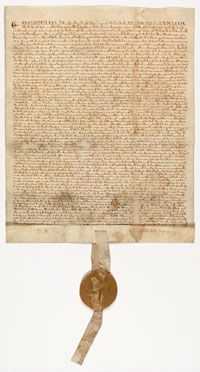
King John and the Magna Carta

In 1215, King John of England was forced to sign the Magna Carta stating that the king was not above the law of the land and protecting the rights of the people. Today, the Magna Carta is considered one of the most important documents in the history of democracy.
Background

John became king in 1199 when his brother, Richard the Lionheart, died without any children. John had a bad temper and could be very cruel. He was not liked by the English Barons.

John also had to deal with a lot of issues while he was king. He was constantly at war with France. To fight this war he placed heavy taxes on the Barons of England. He also angered the Pope and was excommunicated from the church.

The Barons Rebel

By 1215, the barons of northern England had had enough of John's high taxes. They decided to rebel. Led by Baron Robert Fitzwalter, they marched on London calling themselves the "army of God". After taking London, John agreed to negotiate with them.


Signing the Magna Carta 

King John met the barons on June 15, 1215 at Runnymede, a neutral site just west of London. Here the barons demanded that King John sign a document called the Magna Carta guaranteeing them certain rights. By signing the document, King John agreed to do his duty as King of England, upholding the law and running a fair government. In return, the barons agreed to stand down and surrender London. 

Civil War 

It turns out that neither side had any intention of following the agreement. Not long after signing, King John attempted to nullify the agreement. He even had the Pope declare the document "illegal and unjust". At the same time, the barons didn't surrender London. 

Soon the country of England was facing civil war. The barons, led by Robert Fitzwalter, were supported by French troops. For a year the barons fought King John in what is called the First Barons' War. However, King John died in 1216, putting a quick end to the war. 

Details of the Magna Carta 

The Magna Carta was not a short document. There were actually 63 clauses in the document outlining various laws that the barons wanted the King to enforce. Some of the rights these clauses promised included:
  • Protection of church rights
  • Access to swift justice
  • No new taxes without the Barons' agreement
  • Limitations on feudal payments
  • Protection from illegal imprisonment
  • A council of 25 Barons who would insure that King John followed the laws
Legacy 

Although King John did not follow the agreement, the ideas put forth in the Magna Carta became lasting principles of liberty to the English. Three of the clauses are still in force as English law including the freedom of the English Church, the "ancient liberties" of the City of London, and the right to due process. 

The ideas of the Magna Carta also influenced the constitutions and development of other countries. The American colonists used the rights guaranteed in the document as a reason to rebel and form their own country. Many of these rights are written into the United States Constitution and the Bill of Rights. 

Interesting Facts about the Magna Carta
  • Magna Carta is Latin for Great Charter. The document itself was originally written in Latin.
  • King John is often portrayed as the villain in the story of Robin Hood.
  • The council of 25 barons that the Magna Carta formed to watch over the king eventually became the Parliament of England.
  • Archbishop Stephen Langton helped to negotiate the agreement between the two sides. He is also credited with dividing the Bible up into the modern system of chapters used today.
  • The Magna Carta was influenced by the Charter of Liberties signed by King Henry I in 1100.
http://www.ducksters.com/history/middle_ages/king_john_magna_carta.php

Copy and answer these questions in your blog book.

1) The king of what country was forced to sign the Magna Carta?
2) Which king signed the Magna Carta?
3) What year was the Magna Carta signed?
4) True or False: Both sides thought the agreement was good for the country and had every intention of keeping it.

5) In your own words explain why the Magna Carta was considered to be such an important document?