
Wednesday, August 7, 2013

Friday, August 2, 2013
Turbulent Times Create Change
With change comes the opportunity for inspiration, ideas and implementation.

Saturday, July 6, 2013

Sunday, June 23, 2013
Dark Ages
The Dark Ages :The Dark Ages is a term used to describe the period between 400 and 1000 AD in Europe.
Early scholars gave the name "Dark Ages" to the period in Europe after the fall of the Roman Empire. During this period, barbarian Goths, Vandals, and Huns swept down on Europe from the north and east. They destroyed many fine buildings and works of art that had existed during Roman times. During the Dark Ages, knowledge survived only in monasteries, and there were very few schools. Many of the old arts and crafts were lost. This is why the time was called the "Dark Ages."
The eastern Roman Empire was not conquered by the barbarians. There, the arts still flourished. People were still thinking and making fine works of art in other parts of the world. In China and India, great civilizations grew and spread.
In the 1000s, Europe began to slowly recover from its artistic darkness. The lost knowledge of the ancient Greeks and Romans was found again. There was a new interest in learning, and the richer life of the Middle Ages began.
The Age of FeudalismDuring the Dark Ages many changes took place.
 Less writing, education, trade (called the Dark Ages)
Political fragmentation. There were many leaders. The kings had less power because countries were divided into areas controlled by feudal lords. There were many barbaric tribes.
German political traditions differed - People were loyal to a tribe, not to a country. German legal traditions differed - They had laws for individual tribes. German cultural traditions - They had no written literature, and ruins were used for monuments.
The Church preserved ancient writings and Biblical writings. The Christian Church helped unify people of Europe because of its centralized authority and hierarchical nature. The Church unified the people because it was the only constant.
Sunday, May 19, 2013
So,who was Spartacus?

By far the most famous gladiator in history, Spartacus was a Thracian soldier who had been captured and sold into slavery. Lentulus Batiatus of Capua must have recognized his potential, for he purchased him with the intention of turning him into a gladiator. But a warrior’s fierce independence is not easily given up: in 73 BC, Spartacus persuaded seventy of his fellow gladiators—Crixus included—to rebel against Batiatus. This revolt left their former owner murdered in the process, and the gladiators escaped to the slopes of nearby Mount Vesuvius. While in transit, the group set free many other slaves—thereby amassing a large and powerful following.
The gladiators spent the winter of 72 BC training the newly freed slaves in preparation for what is now known as the Third Serville War, as their ranks swelled to as many as 70,000 individuals. Whole legions were sent to kill Spartacus, but these were easily defeated by the fighting spirit and experience of the gladiators. In 71 BC, Marcus Licinius Crassus amassed 50,000 well-trained Roman soldiers to pursue and defeat Spartacus. Crassus trapped Spartacus in Southern Italy, routing his forces, and killing Spartacus in the process. Six thousand of his followers were captured and crucified, their bodies made to line the road from Capua to Rome.
Famous Romans
Here are some of the most famous Romans of all times. These are by far not all famous Romans. For there are too many to mention. But here are some of the most outstanding figures Roman history created - and who created Roman history.
|

|

|

|

|

|

|

Saturday, May 4, 2013
Engineering and Construction
The Romans were excellent engineers and builders. Many of the buildings
and engineering projects they designed are still around today and some
are still being used. Here are some of the projects that the Romans
excelled in:
Roads
Roman Roads were important to the economy and the military of the Romans. They allowed for easier commerce between towns and cities and also allowed the Roman Legions to move quickly around the expanding empire.
The roads were designed to last despite the environment. They were built using many layers of masonry including concrete. These durable roads are still used today. They were also built with a hump making water flow to the edges. This kept the roads from flooding and allowed them to be used in rainy weather.
The Colosseum
The Colosseum in Rome is a great example of Roman engineering and construction. The Colosseum was a large outdoor stadium that could seat around 50,000 people for various forms of entertainment such as gladiator games, mock battles, and dramas. The huge Colosseum is free standing and built with multiple arches to give it strength. Much of it still stands today, although earthquakes have knocked portions of it down. It is 615 feet long and 510 feet wide and took around 131,000 cubic yards of stone to make.
Aqueducts
Aqueducts were long channels that the Romans built to carry water into the cities. Many of the Roman aqueducts were below ground. The water that was carried into the cities was used for drinking water, baths, and sewers. It was generally carried to a public fountain where people could then use buckets to get their water. Roman plumbing became so advanced that many of the large wealthy houses had running water.

Roman Aqueduct
Bridges
The Romans built long durable bridges. Many of their bridges still stand today. They used stone and concrete to build their bridges and used the arch as the basic architectural feature to make them strong. The largest Roman bridge ever built was the Trajan bridge over the river Danube. It was over 3700 feet long and 62 feet high.
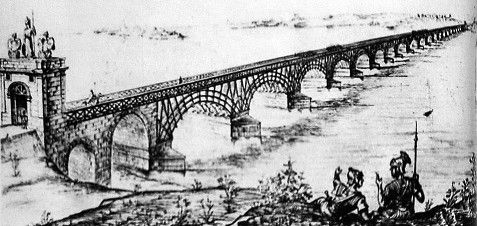
The Trajan Bridge
Architecture
Roman engineering had a large influence on Roman architecture. Arches were used a lot due to their strength. The Romans also used domes as they enabled them to build large ceilings with wide open spaces.
Fun Facts about Roman Engineering
For more information:
http://www.angelfire.com/hi5/interactive_learning/romanbuildingfiles/yr_7_roman_builbing.htm
Roads
Roman Roads were important to the economy and the military of the Romans. They allowed for easier commerce between towns and cities and also allowed the Roman Legions to move quickly around the expanding empire.
The roads were designed to last despite the environment. They were built using many layers of masonry including concrete. These durable roads are still used today. They were also built with a hump making water flow to the edges. This kept the roads from flooding and allowed them to be used in rainy weather.
The Colosseum
The Colosseum in Rome is a great example of Roman engineering and construction. The Colosseum was a large outdoor stadium that could seat around 50,000 people for various forms of entertainment such as gladiator games, mock battles, and dramas. The huge Colosseum is free standing and built with multiple arches to give it strength. Much of it still stands today, although earthquakes have knocked portions of it down. It is 615 feet long and 510 feet wide and took around 131,000 cubic yards of stone to make.
Aqueducts
Aqueducts were long channels that the Romans built to carry water into the cities. Many of the Roman aqueducts were below ground. The water that was carried into the cities was used for drinking water, baths, and sewers. It was generally carried to a public fountain where people could then use buckets to get their water. Roman plumbing became so advanced that many of the large wealthy houses had running water.
Roman Aqueduct
Bridges
The Romans built long durable bridges. Many of their bridges still stand today. They used stone and concrete to build their bridges and used the arch as the basic architectural feature to make them strong. The largest Roman bridge ever built was the Trajan bridge over the river Danube. It was over 3700 feet long and 62 feet high.
The Trajan Bridge
Architecture
Roman engineering had a large influence on Roman architecture. Arches were used a lot due to their strength. The Romans also used domes as they enabled them to build large ceilings with wide open spaces.
Fun Facts about Roman Engineering
- The Romans built over 400,000 km of roads including 29 highways that lead to the city of Rome.
- The Latin word for road is via. The plural of via is viae. Roman roads generally had the name via in them, like the Via Appia or the Via Flaminia.
- All the aqueducts in the city of Rome together totaled around 500 miles in length.
- The Romans were among the first civilizations to harness water power.
- It is estimated that the Romans built over 900 bridges in their empire.
For more information:
http://www.angelfire.com/hi5/interactive_learning/romanbuildingfiles/yr_7_roman_builbing.htm
Subscribe to:
Posts (Atom)