The Ancient Romans fought many battles and wars in order to expand and
protect their empire. There were also civil wars where Romans fought
Romans in order to gain power. Here are some of the major battles and
wars that the Romans fought.
The Punic Wars
The Punic Wars were fought between Rome and Carthage from 264 BC to 146
BC. Carthage was a large City located on the coast of North Africa. This
sounds like a long way away at first, but Carthage was just a short sea
voyage from Rome across the Mediterranean Sea. Both cities were major
powers at the time and both were expanding their empires. As the empires
grew, they began to clash and soon war had begun.
There were three major parts of the Punic wars and they were fought over the course of more than 100 years,
- First Punic War (264 - 241 BC): The First Punic War was
fought largely over the island of Sicily. This meant a lot of the
fighting was at sea where Carthage had the advantage of a much stronger
navy than Rome. However, Rome quickly built up a large navy of over 100
ships. Rome also invented the corvus, a type of assault bridge that
allowed Rome's superior soldiers to board enemy navy vessels. Rome soon
dominated Carthage and won the war.
- Second Punic War (218 - 201 BC): In the Second Punic War,
Carthage had more success fighting against the Roman legions. The
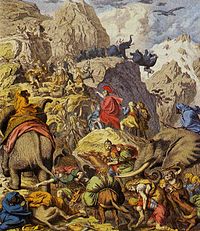
Carthage leader and general, Hannibal, made a daring crossing of the
Alps to attack Rome and northern Italy. This crossing was made more
famous because he also brought a large number of elephants with him.
Hannibal was a brilliant general and won several battles against the
Romans. However, despite fighting for 16 years, Hannibal wasn't able to
conquer the city of Rome. When Rome counterattacked his homeland of
Carthage, Hannibal was forced to retreat. The final battle in this war
was the Battle of Zama where the Roman general Scipio Africanus defeated
Hannibal.
- Third Punic War (149 - 146 BC): In the Third Punic War
Rome attacked the city of Carthage. After three years of laying siege to
the city, the Roman army broke through the walls and burned it to the
ground.
The Battle of Cynoscephalae (364 BC)
In this battle the Roman Legion under Titus Flamininus soundly defeated
the Macedonian Army led by Philip V. This battle was important because
the successors of Greek leader
Alexander the Great had now been defeated. Rome had become the dominant world power.
Third Servile War (73 - 71 BC)
This war started when 78 gladiators, including their leader Spartacus,
escaped and started a rebellion. Soon they had over 120,000 escaped
slaves and others traveling with them invading the countryside. They
successfully fought back many Roman soldiers until finally an army with a
full 8 legions was dispatched to destroy them. The fighting was long
and bitter, but eventually Spartacus' army was defeated.
Caesar's Civil War (49 - 45 BC)
This war is also called the Great Roman Civil War. Julius Caesar's
legions fought against the Senate supported legions of Pompey the Great.
The war lasted for four years until Caesar finally defeated Pompey and
became Dictator of Rome. This signaled the end of the Roman Republic.
The famous moment in this war was when Caesar crossed the Rubicon River.
This meant he was going to war against Rome. Today the term "crossing
the Rubicon" is still used to say that someone had reached the point of
no return and can not go back.
The Battle of Actium (31 BC)
In this battle Octavian's forces, led by Marcus Agrippa, defeated the combined forces of Roman general Marc Antony and
Egyptian Pharaoh
Cleopatra VII. As a result Octavian became the sole power in Rome and
would soon become Rome's first Emperor. He would change his name to
Augustus when he became emperor.
http://www.ducksters.com/history/ancient_roman_wars_battles.php

 Less writing, education, trade (called the Dark Ages)