Total Pageviews

Sunday, November 13, 2016

New England Settlements

Use the handout to help you.

Comprehending cause and effect.


REMEMBER: A cause is why something happens and an effect is what happens.


       CAUSE    (why it happened )                                          EFFECT (what happened)


1..


2.They arrived in November and it was too late to plant crops.


3.


1.The Pilgrims left the netherlands for North
 America.


2.


3.In the fall, the Pilgrims and Wampanoags celebrated Thanksgiving.


Saturday, November 12, 2016

Comparing Colonies


New England
Middle Colonies
“The bread basket colonies”
Southern Colonies
Geography


-Cold
-Poor, rocky soil
-Short growing season
-A lot of glaciers
-A lot of forests
-Poor farming
-Good seas
-Along the Atlantic coast
-Good farmland
-Beavers
-Rivers
-Woods
-Rich and deep soil
-Warm climate
-Rich in timber
-Warm climate
-Good farmland
-Rich soil
-Woods full of animals
-Growing season: 7 or 8 months long
-Tobacco, rice, cotton, indigo
Economics


-Grew wheat, corn, rye, vegetables
-Pigs, sheep and cattle
-Fishing
-Trade slaves
-The farmers produced more than needed
-Sell the crops
-Shops selling clocks, clothes, wigs, tools
-Trades people
-Good place to do business
-Lumberjacks and loggers
-Traded furs, lumber, grain, and meat (sea commerce)
-Sold cash crops: tobacco, rice, cotton, and indigo.
-Slave trade: they used to buy slaves
-Plantations

Society


-Schools for boys (for 6 years)
-Schools for communities with more than 50 families
-Religious freedom
-Puritans
-Puritan Church leaders
-Town crier
-Sundays are religious
-They believed people were equal
-Religious tolerance
-Maryland: refuge for Catholics
-French, Dutch, Germans, Scotch, and Irish
-Quakers
-Organized streets
-Slaves for the plantations and for the rich people’s houses
-Savannah: a penal colony and a safety zone for British and Spanish colonists
-They had parties for the rich
-They had private tutors who went to their houses
-Plantations are far apart
-Rich would go fox hunting
Politics


-Town crier
-Public discussions to solve problems
-Puritan Church leaders
-Laws based on the Bible
-William Penn
-Lord Baltimore (Maryland)
-James Oglethorpe (Georgia)

-Savannah: a penal colony and a safety zone for British and Spanish

Wednesday, November 9, 2016

The Breadbasket Colonies


The Middle Colonies were composed of what is today the states of New York, Pennsylvania, New Jersey and Delaware.
Because the soil was rich in the Middle colonies, farmers were able to grow more grain than they could use. They began selling grain to other colonies and to England, shipping out of the big ports in Philadelphia and New York. Because of this, the middle colonies became known as the Breadbasket colonies.

Source: http://13colonies.mrdonn.org/middlecolonies.html

http://www.slideshare.net/ajroets/61-the-middle-colonies-55805719

Sunday, October 23, 2016

13 Colonies Regions


New England Colonies
    E 

Geograhy and Climate


Economy
Massachusetts, Connecticut,
New Hampshire,
Rhode Island


Religion
Dominated by the Puritans, reformers seeking to “purify” Christianity, who came over from England to practice religion without persecution.
Puritans followed strict rules and were intolerant of other religions, eventually absorbing the separatist Pilgrims.
Life in New England was dominated by church, and there were severe consequences for those who failed to attend, or, those who spoke out against the Puritan ways. Singing and celebrating holidays were among things prohibited in Puritan New England.


Bitterly cold winters and mild summers

Cold winters reduced the spread of disease.

Land was flat close to the coastline but became hilly and mountainous farther inland.
Soil was generally rocky, making farming difficult.


Largely dependent on the ocean. Fishing (especially codfish) was most important to the New England economy, though whaling, trapping, shipbuilding, and logging were important also.
Eventually, many New England shippers grew wealthy buying slaves from West Africa in return for rum, and selling the slaves to the West Indies in return for molasses. This process was called the “triangular trade.”


Middle Colonies
    E 

Geograhy and Climate


Economy
New York, 
Pennsylvania,
New Jersey, 
Delaware


Religion

Religion was varied as no single religion seemed to dominate the entire region. Religious tolerance attracted immigrants from a wide-range of foreign countries who practiced many different religions.
Quakers, Catholics, Jews, Lutherans and Presbyterians were among those religious groups that had significant numbers in the middle colonies.


Colonies spanned the Mid-Atlantic region of America and were temperate in climate with warm summers and cold winters.
Geography ranged from coastal plains along the coastline, piedmont (rolling hills) in the middle, and mountains farther inland. This area had good coastal harbors for shipping.
Climate and land were ideal for agriculture. These colonies were known as the “breadbasket” because of the large amounts of barley, wheat, oats, and rye that were grown here.


A successful and diverse economy. Largely agricultural, farms in this region grew numerous kinds of crops, most notably grains and oats. Logging, shipbuilding, textiles production, and papermaking were also important in the Middle Colonies.
Big cities such as Philadelphia and New York were major shipping hubs, and craftsmen such as blacksmiths, silversmiths, cobblers, wheelwrights, wigmakers, milliners, and others contributed to the economies of such cities.


Southern Colonies
    E 

Geograhy and Climate


Economy
Maryland,
Virginia,
North + South Carolina


Religion

Most people in the Southern Colonies were Anglican (Baptist or Presbyterian), though most of the original settlers from the Maryland colony were Catholic, as Lord Baltimore founded it as a refuge for English Catholics.
 Religion did not have the same impact on communities as in the New England colonies or the Mid-Atlantic colonies because people lived on plantations that were often distant and spread out from one another.


Warm climate with hot summers and mild winters.
Hot summers, however, propagated diseases such as malaria and yellow fever.
Geography ranged from coastal plains in the east to piedmont farther inland. The western most regions were mountainous.
The soil was perfect for farming and the growing season was longer than in any other region. 


The Southern economy was almost entirely based on farming.

Rice, indigo, tobacco, sugarcane, and cotton were cash crops.

Crops were grown on large plantations where slaves and indentured servants worked the land.

In fact, Charleston, South Carolina became one of the centers of the American slave trade in the 1700′s.

Geography of the colonies


http://study.com/academy/lesson/human-cultural-geography-definition-characteristics-studies.html

Tuesday, October 4, 2016

Jamestown : Reading for important information.

1. Read the text you received in class.
2.Copy both graphic organizers in your blog book.
3.Complete the organizers.
4.Reflect on this question: What do settlers need in order to survive and succeed?
5. Come prepared for a dialogue circle.


Important Dates


Who?


The Lost Colony


What happened?


Why?


Important Dates


Who?


Jamestown


What happened?


Why?


Friday, August 19, 2016

Major Explorers


Let’s Review the Major Explorers of the Northwest Passage
Explorer
Sailed For
Area explored

Giovanni Caboto

(known as John Cabot)

(Italian)

England
Northeast coastline of Canada
North America
Giovanni daVerrazano (Italian)

France
New York Bay and mouth of Hudson River East Coast
Jacques Cartier (French)

France
St. Lawrence River Canada
Henry Hudson (English)

Netherlands
Hudson River New York
Hudson Bay, Canada
Samuel de Champlain
(French)

France
St. Lawrence River, Quebec Canada, and northern New York


          In 1493, Christopher Columbus returned to Spain from America with tales of his voyage to the islands he had discovered off the coast of what he thought was India. Soon other countries in Europe began sending ships to explore these new lands seeking the riches they might provide.  One of their primary goals was also to try to find a quicker trade route to Asia, the land of silks and spices.  This search for the Northwest Passage, lead to many new discoveries and claims.  By the early 16th century (1500’s) France, Italy, and England had begun their explorations.
shipline3.gif (918 bytes)
John Cabot 

(Giovanni Caboto)

John Cabot, like Columbus, believed that Asia could be reached by sailing westward.  Cabot, an Italian ship captain, made two voyages to the new world.  In 1497, he sailed for the King of England.  He reached the northern coast of North America in what today is part of Canada.  He sailed southward, exploring possibly as far as New York.
          In 1498, Cabot returned to explore more of this new land.  As a result of his voyages, the English king later claimed the land Cabot explored for England.
shipline3.gif (918 bytes)

Giovanni Da Verrazano

Giovanni da Verrazano:

In 1524, Giovanni da Verrazano, an Italian explorer, sailing for France, reached the eastern coast of North America.  He sailed up and down the coast looking for a passage that would take him west through the continent.  He reached the mouth of the Hudson River in New York Bay, and wrote "we found a very pleasant situation amongst some steep hills ..."
          After rowing ashore in a small boat Verrazano had a brief encounter with a group of Native Americans.  The friendly natives welcomed the strangers, giving them gifts and food.  Verrazano and his crew did not stay long however, due to uncertain weather.
          A bridge connecting Long Island and Staten Island today is named the Verrazano Narrows Bridge, after this early explorer.
shipline3.gif (918 bytes)

Jacques Cartier

          In 1534, the French king, Francis I, sent Jacques Cartier, a French navigator and explorer to North America.  He wanted Cartier to search for gold and other precious metals, as well as to seek a water route through North America. Cartier sailed into what is now the Gulf of St. Lawrence, claiming the land along the river for France.
          
Cartier encountered Native Americans along the shores of the St. Lawrence River.  He gave them gifts and established friendly relations with them.  Today the people of New York state enjoy a state park located on the St. Lawrence River named after Jacques Cartier.

shipline3.gif (918 bytes)

Henry Hudson:

In 1609, an English sea captain, Henry Hudson sailed to America for a Dutch trading company.  Hudson and his crew aboard the ship, Half Moon, were searching for the Northwest Passage.  They sailed into a great river know today as the Hudson. The crew of the Half Moon fished, traded with the Native Americans, and explored the river.  They sailed up the river until it became too shallow to navigate near present-day Albany.  Hudson claimed the land they explored in the Hudson River Valley for Holland.
shipline3.gif (918 bytes)


Samuel de Champlain:


          Samuel de Champlain was a French explorer who became known as the "Father of New France." In 1603 he went on his first voyage to North America on an exploration and fur-trading expedition. He returned a year later, to look for a place in which to make a permanent French settlement. He remained until 1607, exploring the Atlantic coast from Canada to Massachusetts.
          In 1608, Champlain brought a group of settlers to the area along the St. Lawrence River.  They built a trading post and settlement.  It was the first European settlement in Canada.  They called it Quebec. Today it is the oldest city in Canada.
          Champlain befriended the Huron Indians living near Quebec in 1609, and began trading for furs. This peaceful relationship helped make it easier to explore the area. Their friendship also made them allies in battle against the Huron's bitter enemies, the Iroquois. Champlain and his French companions helped the Hurons attack the Iroquois in what is now New York State.  They easily won the battle with their muskets.  It was during this raid that he discovered a lake on the border of northern New York State.  He named this lake, Lake Champlain.  
shipline3.gif (918 bytes)


Definitions
Northwest Passage:  A water route through North America to Asia

Allies:  Partners or friends who help each other
http://www.studyzone.org/testprep/ss5/b/majorexl.cfm

The Silk Road

The Silk Road was a trade route that went from China to Eastern Europe. It went along the northern borders of China, India, and Persia and ended up in Eastern Europe near today's Turkey and the Mediterranean Sea. 

Silk road
Map of the Silk Road - Route in red (later ocean routes in blue)


Why was the Silk Road important? 

The Silk Road was important because it helped to generate trade and commerce between a number of different kingdoms and empires. This helped for ideas, culture, inventions, and unique products to spread across much of the settled world. 

Why is it called the Silk Road? 

It was called the Silk Road because one of the major products traded was silk cloth from China. People throughout Asia and Europe prized Chinese silk for its softness and luxury. The Chinese sold silk for thousands of years and even the Romans called China the "land of silk". 

What goods did the Chinese trade? 

Besides silk, the Chinese also exported (sold) teas, salt, sugar, porcelain, and spices. Most of what was traded was expensive luxury goods. This was because it was a long trip and merchants didn't have a lot of room for goods. They imported, or bought, goods like cotton, ivory, wool, gold, and silver.

How did they travel? 

Merchants and tradesmen traveled in large caravans. They would have many guards with them. Traveling in a big group like a caravan helped in defending from bandits. Camels were popular animals for transport because much of the road was through dry and harsh land. 

History 

Although there was some trade between China and the rest of the world for some time, the silk trade was significantly expanded and promoted by the Han Dynasty which ruled from 206 BC to 220 AD. 

Later, under the rule of the Yuan Dynasty set up by Kublai Khan of the Mongols, trade from China along the Silk Road would reach its peak. During this time the Mongols controlled a significant portion of the trade route, enabling Chinese merchants to travel safely. Also, merchants were granted more social status during the Mongol rule. 

Fun facts about the Silk Road
  • It was over 4,000 miles long.
  • Marco Polo traveled to China along the Silk Road.
  • Not all that was traded along the Silk Road was good. It is thought that the bubonic plague, or Black Death, traveled to Europe from the Silk Road.
  • Very few merchants traveled along the entire route. Goods were traded at many cities and trade posts along the way.
  • There wasn't just one route, but many routes. Some were shorter, but more dangerous. Others took longer, but were safer.

Tuesday, August 2, 2016

Factors for a Successful Civilization

Civilizations need:

1.Education,


2. Water,

3. Communities,


4. Workforce,


5. Army and leadership,


6. Religion,


7. Language,


8. Healthy population,


9. Employment opportunities,  

10.Agriculture.


Age of Exploration - A Short Documentary Film

Why Do People Move to New Places?


In order to prepare for our next dialogue circle, discuss the following questions with your parents:

1. Why do people move to new places, cities or countries?

2. Why do Brazilians leave the country?

3. What forces people to leave their own countries?

4. Is there anything on the news at the moment regarding this topic?

5. How do we choose the best place to move to?


Friday, June 3, 2016

Fall of Rome


http://www.history.com/topics/ancient-history/ancient-rome/videos/the-fall-of-rome (VIDEO TO WATCH)

                           Study Notes in the site below

http://studyhallsuis.weebly.com/roman-army--roman-empire.html


The Fall of Rome

Rome ruled much of Europe around the Mediterranean for over 1000 years. However, the inner workings of the Roman Empire began to decline starting around 200 AD. By 400 AD Rome was struggling under the weight of its giant empire. The city of Rome finally fell in 476 AD. 

The Peak of Roman Power 

Rome reached its peak of power in the 2nd century around the year 117 AD under the rule of the great Roman emperor Trajan. Virtually all of the coastline along the Mediterranean Sea was part of the Roman Empire. This included Spain, Italy, France, southern Britain, Turkey, Israel, Egypt, and northern Africa. 

Gradual Decline 

The Fall of Rome didn't happen in a day, it happened over a long period of time. There are a number of reasons why the empire began to fail. Here are some of the causes of the fall of the Roman Empire:
  • The politicians and rulers of Rome became more and more corrupt
  • Infighting and civil wars within the Empire
  • Attacks from barbarian tribes outside of the empire such as the Visigoths, Huns, Franks, and Vandals.
  • The Roman army was no longer a dominant force
  • The empire became so large it was difficult to govern
Rome Divides into Two 

In 285 AD, Emperor Diocletian decided that the Roman Empire was too big to manage. He divided the Empire into two parts, the Eastern Roman Empire and the Western Roman Empire. Over the next hundred years or so, Rome would be reunited, split into three parts, and split in two again. Finally, in 395 AD, the empire was split into two for good. The Western Empire was ruled by Rome, the Eastern Empire was ruled by Constantinople. 

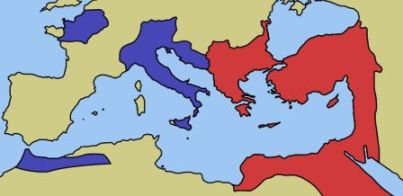
Map of the Eastern and Western Roman Empire right before the fall

The "fall" of Rome discussed here is referring to the Western Roman Empire which was ruled by Rome. The Eastern Roman Empire became known as the Byzantium Empire and remained in power for another 1000 years. 

The City of Rome is Sacked 

The city of Rome was thought by many to be unconquerable. However, in 410 AD, a Germanic barbarian tribe called the Visigoths invaded the city. They looted the treasures, killed and enslaved many Romans, and destroyed many buildings. This was the first time in 800 years that the city of Rome had been sacked. 

Rome Falls 

In 476 AD, a Germanic barbarian by the name of Odoacer took control of Rome. He became king of Italy and forced the last emperor of Rome, Romulus Augustulus, to give up his crown. Many historians consider this to be the end of the Roman Empire. 

The Dark Ages Begins 

With the fall of Rome, many changes occurred throughout Europe. Rome had provided a strong government, education, and culture. Now much of Europe fell into barbarianism. The next 500 years would be known as the Dark Ages of Europe. 

Interesting Facts about the Fall of Rome
  • The Eastern Roman Empire, or Byzantium, fell in 1453 to the Ottoman Empire.
  • Many poor people were glad to see Rome fall. They were starving to death while being taxed heavily by Rome.
  • Near the end of the Roman Empire, the city of Rome was no longer the capital. The city of Mediolanum (now Milan) was capital for a while. Later, the capital was moved to Ravenna.
  • Rome was sacked once again in 455 AD by Geiseric, King of the Vandals. The Vandals were an Eastern Germanic tribe. The term "vandalism" comes from the Vandals.